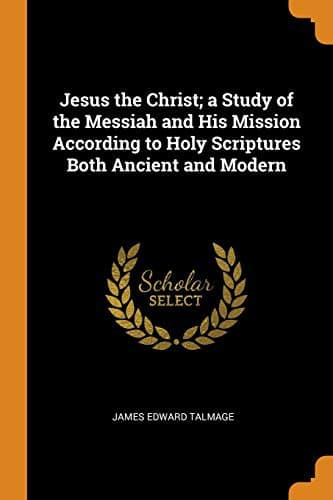
Jesus the Christ: A Study of the Messiah and His Mission According to Holy; Scriptures Both Ancient and ModernTalmage, James E. (James Edward)
Religion
Jesus the Christ: A Study of the Messiah and His Mission According to Holy; Scriptures Both Ancient and Modern
Talmage, James E. (James Edward)
Christian biography -- Palestine; Jesus Christ -- Biography; Jesus Christ -- Mormon interpretations
Jesus found in the woman's words a spirit similar to that with which the
scholarly Nicodemus had received His teachings; each failed alike to
perceive the spiritual lesson He would impart. He explained to her that
water from the well would be of but temporary benefit; to one who drank
of it thirst would return. "But," he added, "whosoever drinketh of the
water that I shall give him shall never thirst; but the water that I
shall give him shall be in him a well of water springing up into
everlasting life." The woman's interest was keenly aroused, either from
curiosity or as an emotion of deeper concern, for she now became the
petitioner, and, addressing Him by a title of respect, said: "Sir, give
me this water, that I thirst not, neither come hither to draw." She
could see nothing beyond the material advantage attaching to water that
would once and for all quench thirst. The result of the draught she had
in mind would be to give her immunity from one bodily need, and save her
the labor of coming to draw from the well.
The subject of the conversation was abruptly changed by Jesus bidding
her to go, call her husband, and return. To her reply that she had no
husband Jesus revealed to her His superhuman powers of discernment, by
telling her she had spoken truthfully, inasmuch as she had had five
husbands, while the man with whom she was then living was not her
husband. Surely no ordinary being could have so read the unpleasing
story of her life; she impulsively confessed her conviction, saying:
"Sir, I perceive that thou art a prophet." She desired to turn the
conversation, and, pointing to Mount Gerizim, upon which the
sacrilegious priest Manasseh had erected a Samaritan temple, she
remarked with little pertinence to what had been said before: "Our
fathers worshipped in this mountain; and ye say, that in Jerusalem is
the place where men ought to worship." Jesus replied in yet deeper vein,
telling her that the time was near when neither that mountain nor
Jerusalem would be preeminently a place of worship; and He clearly
rebuked her presumption that the traditional belief of the Samaritans
was equally good with that of the Jews; for, said He: "Ye worship ye
know not what: we know what we worship: for salvation is of the Jews."
Changed and corrupted as the Jewish religion had become, it was better
than that of her people; for the Jews did accept the prophets, and
through Judah the Messiah had come. But, as Jesus expounded the matter
to her, the place of worship was of lesser importance than the spirit of
the worshiper. "God is a Spirit: and they that worship him must worship
him in spirit and in truth."
Public-domain text, read in full here on John Shaqi.
Reviews
Reviews
No reviews yet
Be the first to share your thoughts on this work.
Elsewhere in the archive
Join the Discussion
Join the discussion
Sign in to leave a comment or review.
Sign InorCreate an account