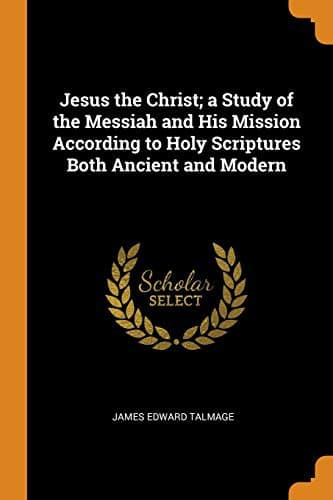
Jesus the Christ: A Study of the Messiah and His Mission According to Holy; Scriptures Both Ancient and ModernTalmage, James E. (James Edward)
Religion
Jesus the Christ: A Study of the Messiah and His Mission According to Holy; Scriptures Both Ancient and Modern
Talmage, James E. (James Edward)
Christian biography -- Palestine; Jesus Christ -- Biography; Jesus Christ -- Mormon interpretations
"Happiness includes all that is really desirable and of true worth in
pleasure, and much beside. Happiness is genuine gold, pleasure but
gilded brass, which corrodes in the hand, and is soon converted into
poisonous verdigris. Happiness is as the genuine diamond, which, rough
or polished, shines with its own inimitable luster; pleasure is as the
paste imitation that glows only when artificially embellished. Happiness
is as the ruby, red as the heart's blood, hard and enduring; pleasure,
as stained glass, soft, brittle, and of but transitory beauty.
"Happiness is true food, wholesome, nutritious and sweet; it builds up
the body and generates energy for action, physical, mental and
spiritual; pleasure is but a deceiving stimulant which, like spirituous
drink, makes one think he is strong when in reality enfeebled; makes him
fancy he is well when in fact stricken with deadly malady.
"Happiness leaves no bad after-taste, it is followed by no depressing
reaction; it calls for no repentance, brings no regret, entails no
remorse; pleasure too often makes necessary repentance, contrition, and
suffering; and, if indulged to the extreme, it brings degradation and
destruction.
"True happiness is lived over and over again in memory, always with a
renewal of the original good; a moment of unholy pleasure may leave a
barbed sting, which, like a thorn in the flesh, is an ever-present
source of anguish.
"Happiness is not akin with levity, nor is it one with light-minded
mirth. It springs from the deeper fountains of the soul, and is not
infrequently accompanied by tears. Have you never been so happy that you
have had to weep? I have." From an article by the author, _Improvement
Era_, vol. 17, No. 2, pp. 172, 173.
3. Salt of the Earth.--Dummelow's _Commentary_, on Matt. 5:13, states:
"Salt in Palestine, being gathered in an impure state, often undergoes
chemical changes by which its flavor is destroyed while its appearance
remains." Perhaps a reasonable interpretation of the expression, "if the
salt have lost his savor," may be suggested by the fact that salt mixed
with insoluble impurities may be dissolved out by moisture, leaving the
insoluble residue but slightly salty. The lesson of the Lord's
illustration is that spoiled salt is of no use as a preservative. The
corresponding passage in the sermon delivered by Jesus to the Nephites
after His resurrection reads: "Verily, verily, I say unto you, I give
unto you to be the salt of the earth; but if the salt shall lose its
savor, wherewith shall the earth be salted? The salt shall be
thenceforth good for nothing, but to be cast out, and to be trodden
under foot of men." (3 Nephi 12:13.)
Public-domain text, read in full here on John Shaqi.
Reviews
Reviews
No reviews yet
Be the first to share your thoughts on this work.
Elsewhere in the archive
Join the Discussion
Join the discussion
Sign in to leave a comment or review.
Sign InorCreate an account