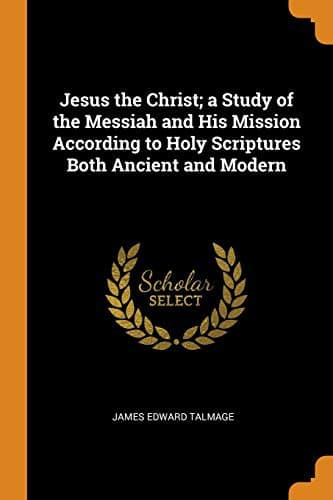
Jesus the Christ: A Study of the Messiah and His Mission According to Holy; Scriptures Both Ancient and ModernTalmage, James E. (James Edward)
Religion
Jesus the Christ: A Study of the Messiah and His Mission According to Holy; Scriptures Both Ancient and Modern
Talmage, James E. (James Edward)
Christian biography -- Palestine; Jesus Christ -- Biography; Jesus Christ -- Mormon interpretations
While the Lord was making His second missionary tour through Galilee,
going about through "all the cities and villages, teaching in their
synagogues, and preaching the gospel of the kingdom, and healing every
sickness and every disease among the people,"[595] the absurd theory
that Christ was Himself a victim of demoniacal possession, and that He
operated by the power of the devil, was urged and enlarged upon until it
became the generally accepted explanation among the Pharisees and their
kind. Jesus had withdrawn Himself for a time from the more populous
centers, where He was constantly watched by emissaries, whom the ruling
classes had sent from Jerusalem into Galilee; for the Pharisees were in
conspiracy against Him, seeking excuse and opportunity to take His life;
but even in the smaller towns and rural districts He was followed and
beset by great multitudes, to whom He ministered for both physical and
spiritual ailments.[596]
He urged the people to refrain from spreading His fame; and this He may
have done for the reason that at that stage of His work an open rupture
with the Jewish hierarchy would have been a serious hindrance; or
possibly He desired to leave the rulers, who were plotting against Him,
time and opportunity to brew their bitter enmity and fill to the brim
the flagons of their determined iniquity. Matthew sees in the Lord's
injunctions against publicity a fulfilment of Isaiah's prophecy that the
chosen Messiah would not strive nor cry out on the street to attract
attention, nor would He use His mighty power to crush even a bruised
reed, or to quench even the smoking flax; He would not fail nor be
discouraged, but would victoriously establish just judgment upon the
earth for the Gentiles, as well as, by implication, for Israel.[597] The
figure of the bruised reed and the smoking flax is strikingly expressive
of the tender care with which Christ treated even the weakest
manifestation of faith and genuine desire to learn the truth, whether
exhibited by Jew or Gentile.
Public-domain text, read in full here on John Shaqi.
Reviews
Reviews
No reviews yet
Be the first to share your thoughts on this work.
Elsewhere in the archive
Join the Discussion
Join the discussion
Sign in to leave a comment or review.
Sign InorCreate an account