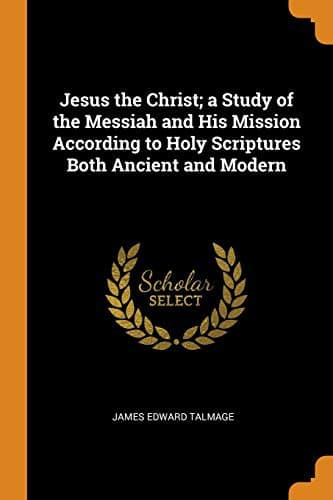
Jesus the Christ: A Study of the Messiah and His Mission According to Holy; Scriptures Both Ancient and ModernTalmage, James E. (James Edward)
Religion
Jesus the Christ: A Study of the Messiah and His Mission According to Holy; Scriptures Both Ancient and Modern
Talmage, James E. (James Edward)
Christian biography -- Palestine; Jesus Christ -- Biography; Jesus Christ -- Mormon interpretations
Then, the demonstration being complete, and the absurdity of His
opponents' assumption proved, Christ directed their thoughts to the
heinous sin of condemning the power and authority by which Satan was
overcome. He had proved to them on the basis of their own proposition
that He, having subdued Satan, was the embodiment of the Spirit of God,
and that through Him the kingdom of God was brought to them. They
rejected the Spirit of God, and sought to destroy the Christ through
whom that Spirit was made manifest. What blasphemy could be greater?
Speaking as one having authority, with the solemn affirmation "I say
unto you," He continued: "All manner of sin and blasphemy shall be
forgiven unto men: but the blasphemy against the Holy Ghost shall not be
forgiven unto men. And whosoever speaketh a word against the Son of man,
it shall be forgiven him: but whosover speaketh against the Holy Ghost,
it shall not be forgiven him, neither in this world, neither in the
world to come."
Who among men can word a more solemn and awful warning against the
danger of committing the dread unpardonable sin?[599] Jesus was merciful
in His assurance that words spoken against Himself as a Man, might be
forgiven; but to speak against the authority He possessed, and
particularly to ascribe that power and authority to Satan, was very near
to blasphemy against the Holy Ghost, for which sin there could be no
forgiveness. Then, in stronger terms, which developed into cutting
invective, He told them to be consistent--if they admitted that the
result of His labors was good, as the casting out of devils surely was,
to be likened unto good fruit--why did they not acknowledge that the
power by which such results were attained, in other words that the tree
itself, was good? "Either make the tree good, and his fruit good; or
else make the tree corrupt, and his fruit corrupt: for the tree is known
by his fruit." With burning words of certain conviction He continued: "O
generation of vipers, how can ye, being evil, speak good things? for out
of the abundance of the heart the mouth speaketh." By the truths He had
made so plain it was evident that their accusing words were drawn from
hearts stored with evil treasure. Moreover their words were shown to be
not only malicious but foolish, idle and vain, and therefore doubly
saturated with sin. Another authoritative declaration followed: "But I
say unto you, That every idle word that men shall speak, they shall give
account thereof in the day of judgment."
SEEKERS AFTER SIGNS?[600]
Public-domain text, read in full here on John Shaqi.
Reviews
Reviews
No reviews yet
Be the first to share your thoughts on this work.
Elsewhere in the archive
Join the Discussion
Join the discussion
Sign in to leave a comment or review.
Sign InorCreate an account