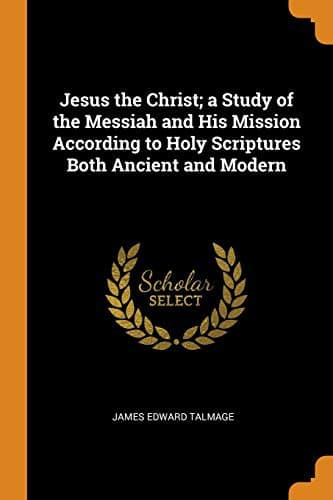
Jesus the Christ: A Study of the Messiah and His Mission According to Holy; Scriptures Both Ancient and ModernTalmage, James E. (James Edward)
Religion
Jesus the Christ: A Study of the Messiah and His Mission According to Holy; Scriptures Both Ancient and Modern
Talmage, James E. (James Edward)
Christian biography -- Palestine; Jesus Christ -- Biography; Jesus Christ -- Mormon interpretations
Individual rabbis gathered disciples about them, and, inevitably,
rivalry became manifest. Rabbinical schools and academies were
established, each depending for its popularity on the greatness of some
rabbi. The most famous of these institutions in the time of Herod I.
were the school of Hillel and that of his rival Shammai. Later,
tradition invested these with the title "the fathers of old." It appears
from the trifling matters over which the followers of these two
disagreed, that only by opposition could either maintain a
distinguishing status. Hillel is reputed as the grandfather of Gamaliel,
the rabbi and doctor of the law at whose feet Saul of Tarsus, afterward
Paul the apostle, received his early instruction (Acts 22:3). So far as
we have historic record of the views, principles or beliefs advocated by
the rival schools of Hillel and Shammai, it appears that the former
stood for a greater degree of liberality and tolerance, while the later
emphasized a strict and possibly narrow interpretation of the law and
its associated traditions. The dependence of the rabbinical schools on
the authority of tradition is illustrated by an incident of record to
the effect that even the prestige of the great Hillel did not insure him
against uproar when once he spoke without citing precedent; only when he
added that so had his masters Abtalion and Shemajah spoken did the
tumult subside.
4. Sadducean Denial of the Resurrection.--As set forth in the text, the
Sadducees formed an association numerically small as compared with the
more popular and influential Pharisees. In the Gospels the Pharisees are
of frequent mention, and very commonly in connection with the scribes,
while the Sadducees are less frequently named. In the Acts of the
Apostles, the Sadducees appear frequently as opponents of the Church.
This condition was doubtless due to the prominence given the
resurrection from the dead among the themes of the apostolic preaching,
the Twelve continually bearing testimony to the actual resurrection of
Christ. Sadducean doctrine denied the actuality and possibility of a
bodily resurrection, the contention resting mainly on the ground that
Moses, who was regarded as the supreme mortal lawgiver in Israel, and
the chief mouthpiece of Jehovah, had written nothing concerning life
after death. The following is taken from Smith's _Dictionary of the
Bible_, article "Sadducees," as touching this matter: "The denial of
man's resurrection after death followed in the conception of the
Sadducees as a logical conclusion from their denial that Moses had
revealed to the Israelites the Oral Law. For on a point so momentous as
a second life beyond the grave, no religious party among the Jews would
have deemed themselves bound to accept any doctrine as an article of
faith, unless it had been proclaimed by Moses, their great legislator;
and it is certain that in the written Law of the Pentateuch there is a
Public-domain text, read in full here on John Shaqi.
Reviews
Reviews
No reviews yet
Be the first to share your thoughts on this work.
Elsewhere in the archive
Join the Discussion
Join the discussion
Sign in to leave a comment or review.
Sign InorCreate an account