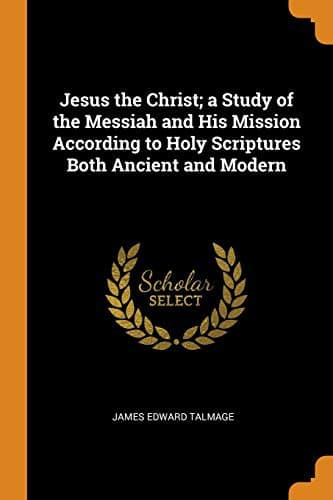
Jesus the Christ: A Study of the Messiah and His Mission According to Holy; Scriptures Both Ancient and ModernTalmage, James E. (James Edward)
Religion
Jesus the Christ: A Study of the Messiah and His Mission According to Holy; Scriptures Both Ancient and Modern
Talmage, James E. (James Edward)
Christian biography -- Palestine; Jesus Christ -- Biography; Jesus Christ -- Mormon interpretations
6. State of the World at the Time of the Savior's Birth.--At the
beginning of the Christian era, the Jews, in common with most other
nations, were subjects of the Roman empire. They were allowed a
considerable degree of liberty in maintaining their religious
observances and national customs generally, but their status was far
from that of a free and independent people. The period was one of
comparative peace--a time marked by fewer wars and less dissension than
the empire had known for many years. These conditions were favorable for
the mission of the Christ, and for the founding of His Church on earth.
The religious systems extant at the time of Christ's earthly ministry
may be classified in a general way as Jewish and Pagan, with a minor
system--the Samaritan--which was essentially a mixture of the other two.
The children of Israel alone proclaimed the existence of the true and
living God; they alone looked forward to the advent of the Messiah, whom
mistakenly they awaited as a prospective conqueror coming to crush the
enemies of their nation. All other nations, tongues, and peoples, bowed
to pagan deities, and their worship comprized nought but the sensual
rites of heathen idolatry. Paganism was a religion of form and ceremony,
based on polytheism--a belief in the existence of a multitude of gods,
which deities were subject to all the vices and passions of humanity,
while distinguished by immunity from death. Morality and virtue were
unknown as elements of heathen service; and the dominant idea in pagan
worship was that of propitiating the gods, in the hope of averting their
anger and purchasing their favor.--See the author's _The Great
Apostasy_, 1:2-4, and notes following the chapter cited.
FOOTNOTES:
[144] Exo. 33:11; see also Numb. 12:8; Deut. 34:10; compare P. of G.P.,
Moses 1:2, 11, 31.
[145] P. of G.P., Moses 5:57; for later mention of the "meridian of
time," see 6:56-62; and 7:46; and compare Doc. and Cov. 20:26; 39:3.
[146] "Meridian: ... figuratively, the highest point or
culminating-point of anything; the zenith; as the meridian of
life."--"New Stand. Dict."
[147] B. of M., 3 Nephi 2:8; compare 4 Nephi 1:1, 21; Mormon 8:6; Moroni
10:1.
[148] Gen. 32:28; 35:10.
[149] Exo. 1:1, 7; 9:6, 7; 12:3, etc.
[150] Exo. 12:35, 40; 13:19; 15:1; Numb. 20:1, 19, 24, etc.
[151] See mention throughout the books of Judges, 1 and 2 Samuel, 1 and
2 Kings, and references therein.
[152] Isa. 11:13; 17:3; Ezek, 37:16-22; Hos. 4:17.
[153] Jer. 25:11, 12; see also 29:10.
[154] Ezra 1:1-4; the author, "House of the Lord," pp. 47-53; also
"Articles of Faith" xvii:1-22.
[155] Ezra 2:64-67.
[156] "House of the Lord," pp. 51-53.
[157] Josephus, Ant. xii:6 and 7; 2 Maccabees 2:19; 10:1-8; also John
10:22.
[158] Luke 2:1.
[159] Matt. 2:1. Page 106.
[160] Note 1, end of chapter.
[161] Deut. 7:6; see also 10:15; Exo. 19:5, 6; Psa. 135:4; Isa. 41:8;
45:4; compare 1 Peter 2:9.
[162] Note 6, end of chapter.
[163] 2 Kings 17:24.
Public-domain text, read in full here on John Shaqi.
Reviews
Reviews
No reviews yet
Be the first to share your thoughts on this work.
Elsewhere in the archive
Join the Discussion
Join the discussion
Sign in to leave a comment or review.
Sign InorCreate an account