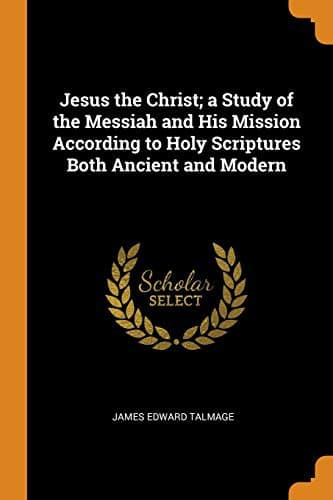
Jesus the Christ: A Study of the Messiah and His Mission According to Holy; Scriptures Both Ancient and ModernTalmage, James E. (James Edward)
Religion
Jesus the Christ: A Study of the Messiah and His Mission According to Holy; Scriptures Both Ancient and Modern
Talmage, James E. (James Edward)
Christian biography -- Palestine; Jesus Christ -- Biography; Jesus Christ -- Mormon interpretations
Six months after the visitation of Gabriel to Zacharias, and three
months prior to the birth of John, the same heavenly messenger was sent
to a young woman named Mary, who lived at Nazareth, a town in Galilee.
She was of the lineage of David; and though unmarried was betrothed or
espoused to a man named Joseph, who also was of royal descent through
the Davidic line. The angel's salutation, while full of honor and
blessing, caused Mary to wonder and to feel troubled. "Hail, thou that
art highly favoured, the Lord is with thee: blessed art thou among
women";[200] thus did Gabriel greet the virgin.
In common with other daughters of Israel, specifically those of the
tribe of Judah and of known descent from David, Mary had doubtless
contemplated, with holy joy and ecstasy, the coming of the Messiah
through the royal line; she knew that some Jewish maiden was yet to
become the mother of the Christ. Was it possible that the angel's words
to her had reference to this supreme expectation and hope of the nation?
She had little time to turn these things in her mind, for the angel
continued: "Fear not, Mary: for thou hast found favour with God. And,
behold, thou shalt conceive in thy womb, and bring forth a son, and
shalt call his name JESUS. He shall be great, and shall be called the
Son of the Highest: and the Lord God shall give unto him the throne of
his father David: and he shall reign over the house of Jacob for ever;
and of his kingdom there shall be no end."[201]
Even yet she comprehended but in part the import of this momentous
visitation. Not in the spirit of doubt such as had prompted Zacharias to
ask for a sign, but through an earnest desire for information and
explanation, Mary, conscious of her unmarried status and sure of her
virgin condition, asked: "How shall this be, seeing I know not a man?"
The answer to her natural and simple inquiry was the announcement of a
miracle such as the world had never known--not a miracle in the sense of
a happening contrary to nature's law, nevertheless a miracle through the
operation of higher law, such as the human mind ordinarily fails to
comprehend or regard as possible. Mary was informed that she would
conceive and in time bring forth a Son, of whom no mortal man would be
the father:--"And the angel answered and said unto her, The Holy Ghost
shall come upon thee, and the power of the Highest shall overshadow
thee: therefore also that holy thing which shall be born of thee shall
be called the Son of God."[202]
Then the angel told her of the blessed condition of her cousin
Elisabeth, who had been barren; and by way of sufficient and final
explanation added: "For with God nothing shall be impossible." With
gentle submissiveness and humble acceptance, the pure young virgin
replied: "Behold the handmaid of the Lord; be it unto me according to
thy word."
Public-domain text, read in full here on John Shaqi.
Reviews
Reviews
No reviews yet
Be the first to share your thoughts on this work.
Elsewhere in the archive
Join the Discussion
Join the discussion
Sign in to leave a comment or review.
Sign InorCreate an account