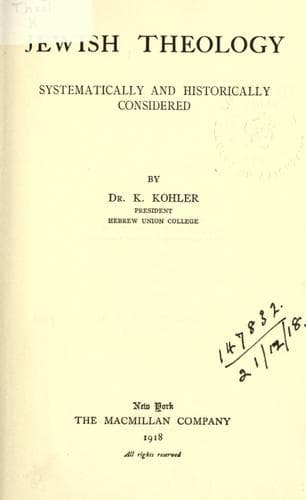
Jewish Theology, Systematically and Historically ConsideredKohler, Kaufmann
Religion
Jewish Theology, Systematically and Historically Considered
Kohler, Kaufmann
Judaism -- Doctrines
1. A leading objection to the belief in divine Providence is the existence
in this world of physical and moral evil. All living creatures are exposed
to the influence of evil, according to their physical or moral
constitutions and the peculiar conditions of their existence. Heathenism
accounts for the powers of darkness, pain and death by assuming the
existence of forces hostile to the heavenly powers of light and life, or
of a primitive principle of evil, the counterpart of the divine beings.
But to those who believe in an almighty and all-benign Creator and Ruler
of the universe, the question remains: Why do life and the love of life
encounter so many hindrances? Why does God’s world contain so much pain
and bitterness, so much passion and sin? Should not Providence have
averted such things? The answer of Judaism has already been stated here,
but we need further elaboration of the theme that there is no evil before
God, since a good purpose is served even by that which appears bad. In the
life of the human body pleasure and pain, the impetus to life and its
restraint and inhibition form a necessary contrast, making for health; so,
in the moral order of the universe, each being who battles with evil
receives new strength for the unfolding of the good. The principle of
holiness, which culminates in Israel’s holy God, transforms and ennobles
every evil. As the Midrash explains, referring to Deut. XI, 26: “If thou
but seest that both good and evil are placed in thy hand, no evil will
come to thee from above, since thou knowest how to turn it into
good.”(523)
2. The conception of evil passed through a development parallel with that
of the related conceptions which we have just reviewed. At first every
misfortune was considered to be inflicted by divine wrath as a punishment
for human misdeeds. Nations and individuals were thought to suffer for
some special moral cause; through suffering they were punished for past
wrong, warned against its repetition in the future, and urged to
repentance and improvement of their conduct. Even death, the fate of all
living creatures, was regarded as a punishment which the first pair of
human beings brought upon all their descendants through their
transgression of the divine command. The Talmudic sages clung to the view
of the Paradise legend in the Bible, when they held that every death is
due to some sin committed by the individual.(524)
Public-domain text, read in full here on John Shaqi.
Reviews
Reviews
No reviews yet
Be the first to share your thoughts on this work.
Elsewhere in the archive
Join the Discussion
Join the discussion
Sign in to leave a comment or review.
Sign InorCreate an account