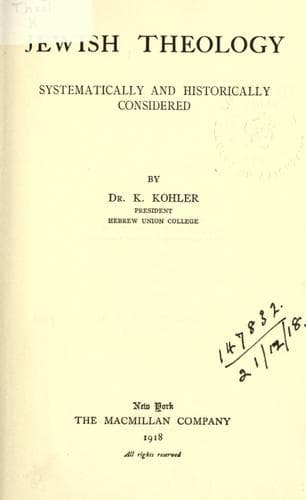
Jewish Theology, Systematically and Historically ConsideredKohler, Kaufmann
Religion
Jewish Theology, Systematically and Historically Considered
Kohler, Kaufmann
Judaism -- Doctrines
7. In spite of this, none of the medieval Jewish philosophers doubted the
existence of angels.(552) Indeed, there was no reason for them to do so,
as they had managed to insert them into their philosophic systems as
intermediary beings leading up to the Supreme Intelligence. All that was
necessary was to identify the angels of the Bible with the “ideas” of
Plato or the “rulers of the spheres,” the “separate intelligences” of
Aristotle. By this one step the existence of angels as cosmic powers was
proved to be a logical necessity. The ten rulers of the spheres even
corresponded with the ten orders of angels in the cosmography of the
Jewish, Mohammedan, and Christian schoolmen. The only difference between
the Aristotelian and the rabbinical views was that the former held the
cosmic powers to be eternal; the latter, that they were created.
In both Biblical and rabbinical literature the angels are usually
conceived of as purely spiritual powers superior to man. Maimonides,
however, following his rationalistic method, declared them to be simply
products of the imagination, the hypostases of figurative expressions
which were not meant to be taken literally. To him every force and element
of nature is an angel or messenger of God. In this way the entire
angelology of the Bible, including even Ezekiel’s vision of the heavenly
chariot (the _Merkabah_), in becoming a part of the Maimonidean system
turns into natural philosophy pure and simple.(553) Of course, Saadia,
Jehuda ha Levi, and Gabirol do not share this rationalistic view. To them
the angels are either cosmic powers of an ethereal substance, endowed with
everlasting life, or living beings created by God for special
purposes.(554)
The later Cabbalistic lore extended the realm of the celestial spirits
still more, creating new names of angels for its mystical system and its
magical practices. Yet in this magic it subordinated the angels to man. In
fact, it followed Saadia largely in this, making man the center and
pinnacle of the work of creation, in fact, the very mirror of the
Creator.(555)
Public-domain text, read in full here on John Shaqi.
Reviews
Reviews
No reviews yet
Be the first to share your thoughts on this work.
Elsewhere in the archive
Join the Discussion
Join the discussion
Sign in to leave a comment or review.
Sign InorCreate an account