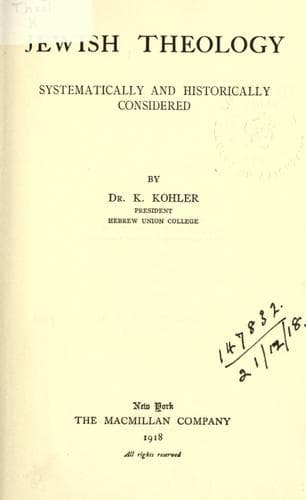
Jewish Theology, Systematically and Historically ConsideredKohler, Kaufmann
Religion
Jewish Theology, Systematically and Historically Considered
Kohler, Kaufmann
Judaism -- Doctrines
2. Just as the references to God’s appearing to man suggested luminous
powers mediating the vision of God, so the passages which represent God as
speaking suggest powers mediating the voice. Hence arose the conception of
the divine _Word_, invested with divine powers both physical and
spiritual. The first act of God in the Bible is that He spoke, and by this
word the world came into being. The _Word_ was thus conceived of as the
first created being, an intermediary power between the Spirit of the world
and the created world order. The word of God, important in the cosmic
order, is still more so in the moral and spiritual worlds. The Word is at
times a synonym of divine revelation to the men of the early generations
or to Israel, the bearer of the Law. Hence the older Haggadah places
beside the _Shekinah_ the divine _Word_ (Hebrew, _Maamar_; Aramaic,
_Memra_; Greek, _Logos_) as the intermediary force of revelation.
Contact with the Platonic and Stoic philosophies led gradually to a new
development which appears in Philo. The Word or Logos becomes “the
first-created Son of God,” having a personality independent from God; in
fact he is a kind of vice regent of God himself. From this it was but a
short step toward considering him a partner and peer of the Almighty, as
was done by the Church with its doctrine that the Word became flesh in
Christ, the son of God.(595) In view of this the rabbinical schools gave
up the idea of the personified Word, replacing it with the _Torah_ or the
_Spirit of God_. The older term was retained only in liturgical formulas,
such as: “Who created the heavens by His Word,” or, “Who by His Word
created the twilight and by Wisdom openeth the gates of heaven.”(596)
3. As has been shown above,(597) Wisdom is described in the Bible as the
first of all created beings, the assistant and counselor of God in the
work of creation. Then we see that Ben Sira identifies Wisdom with the
Torah.(598) Thus the Torah, too, was raised to a cosmic power, the sum and
substance of all wisdom. In fact, the Torah, like the Logos of Plato, was
regarded as comprising the ideas or prototypes of all things as in a
universal plan. The Torah is the divine pattern for the world. In such a
connection _Torah_ is far from meaning the Law, as Weber asserts.(599) It
means rather the heavenly book of instruction which contains all the
wisdom of the ages, and which God himself used as guide at the Creation.
God is depicted as an architect with His plan drafted before He began the
erection of the edifice,—a conception which avoids all danger of deifying
the Logos.
Public-domain text, read in full here on John Shaqi.
Reviews
Reviews
No reviews yet
Be the first to share your thoughts on this work.
Elsewhere in the archive
Join the Discussion
Join the discussion
Sign in to leave a comment or review.
Sign InorCreate an account