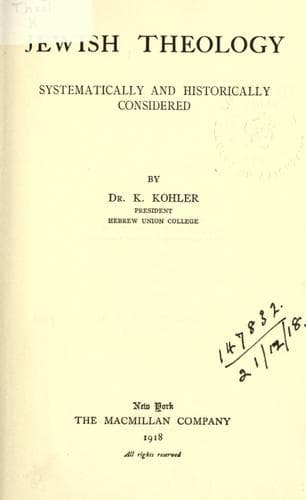
Jewish Theology, Systematically and Historically ConsideredKohler, Kaufmann
Religion
Jewish Theology, Systematically and Historically Considered
Kohler, Kaufmann
Judaism -- Doctrines
9. At any rate, Judaism recognizes no sin which does not arise from the
individual conscience or moral personality. The condemnation of a whole
generation or race in consequence of the sin of a single individual is an
essentially heathen idea, which was overcome by Judaism in the course of
time through the prophetic teaching of the divine justice and man’s moral
responsibility. This sentiment was voiced by Moses and Aaron after the
rebellion of Korah in the words: “O God, the God of the spirits of all
flesh, shall one man sin, and wilt Thou be wroth with all the
congregation?”(758) In commenting upon this, the Midrash says: “A human
king may make war upon a whole province, because it contains rebels who
have caused sedition, and so the innocent must suffer together with the
guilty; but it does not behoove God, the Ruler of the spirits, who looks
into the hearts of men, to punish the guiltless together with the
guilty.”(759) The Christian view of universal guilt as a consequence of
Adam’s sin, the dogma of original sin, is actually a relapse from the
Jewish stage to the heathen doctrine from which the Jewish religion freed
itself.
10. According to the Biblical view sin contaminates man, so that he cannot
stand in the presence of God. The holiness of Him who is “of eyes too pure
to behold evil”(760) becomes to the sinner “a devouring fire.”(761) Even
the lofty prophet Isaiah realizes his own human limitations at the sublime
vision of the God of holiness enthroned on high, while the angelic
choruses chant their thrice holy. In humility and contrition he cries out:
“Woe is me, for I am undone! Because I am a man of unclean lips, and I
dwell in the midst of a people of unclean lips; For mine eyes have seen
the King, the Lord of hosts.”(762) The prophet must undergo atonement in
order to be prepared for his high prophetic task. One of the Seraphs
purges him of his sins by touching his lips with a live coal taken from
the altar of God.
Under the influence of Persian dualism, rabbinical Judaism considers sin a
pollution which puts man under the power of unclean spirits.(763) In the
later Cabbalah this idea is elaborated until the world of sin is
considered a cosmic power of impurity, opposed to the realm of right,
working evil ever since the fall of Adam.(764) Still, however close this
may come to the Christian dogma, it never becomes identical with it; the
recognition is always preserved of man’s power to extricate himself from
the realm of impurity and to elevate himself into the realm of purity by
his own repentance. Sin never becomes a demoniacal power depriving man of
his divine dignity of self-determination and condemning him to eternal
damnation. It ever remains merely a going astray from the right path, a
stumbling from which man may rise again to his heavenly height, exerting
his own powers as the son of God.
Chapter XXXIX. Repentance Or the Return To God
Public-domain text, read in full here on John Shaqi.
Reviews
Reviews
No reviews yet
Be the first to share your thoughts on this work.
Elsewhere in the archive
Join the Discussion
Join the discussion
Sign in to leave a comment or review.
Sign InorCreate an account