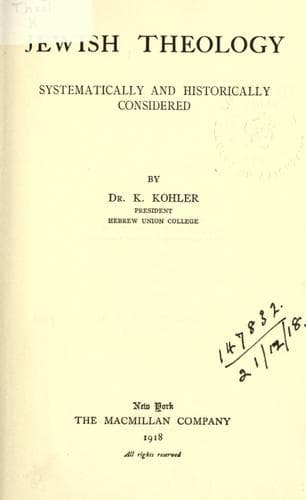
Jewish Theology, Systematically and Historically ConsideredKohler, Kaufmann
Religion
Jewish Theology, Systematically and Historically Considered
Kohler, Kaufmann
Judaism -- Doctrines
5. According to our modern thinking there can be no question of any
influence upon a Deity exalted above time and space, omniscient,
unchangeable in will and action, by the prayer of mortals. Prayer can
exert power only over the relation of man to God, not over God Himself.
This indicates the nature and purpose of prayer. Man often feels lonely
and forlorn in a world which overpowers him, to which he feels superior,
and yet which he cannot master. Therefore he longs for that unseen Spirit
of the universe, with whom alone he feels himself akin, and in whom alone
he finds peace and bliss amid life’s struggle and unrest. This longing is
both expressed and satisfied in prayer. Following the natural impulse of
his soul, man must pour out before his God all his desires and sighs, all
the emotions of grief and delight which sway his heart, in order that he
may find rest, like a child at its mother’s bosom. Therefore the childlike
mind believes that God can be induced to come down from His heavenly
heights to offer help, and that He can be moved and influenced in human
fashion. The truth is that every genuine prayer lifts man up toward God,
satisfies the desire for His hallowing presence, unlocks the heavenly gate
of mercy and bliss, and bestows upon man the beatific and liberating sense
of being a child of God. The intellect may question the effect of prayer
upon the physical, mental, or social constitution of man, or may declare
prayer to be pious self-deception. The religious spirit experiences in
prayer the soaring up of the soul toward union with God in consecrated
moments of our mortal pilgrimage. This is no deception. The man who prays
receives from the Godhead, toward whom he fervently lifts himself, the
power to defy fate, to conquer sin, misery, and death. “The Lord is nigh
to all them that call upon Him, to all that call upon Him in truth.”(868)
6. To pray, then, is to look up to God and to pour out before Him one’s
wishes, thoughts, sorrows, and joys. Certainly the All-knowing does not
require to be told by us what we desire or what we need. “For there is not
a word in my tongue, but lo, O Lord, Thou knowest it altogether.”(869) But
we mortals merely aspire toward Him who bears the world on His eternal
arms, to express in His presence our agony and our jubilation, because we
are certain of His paternal sympathy. When we praise and extol Him for the
happiness and the many pleasures which He has granted us, He becomes the
Partaker and Protector of our fortune, just as He is our sympathetic
Helper when we cry out to Him under the burden of sin or grief, in the
anxiety of danger or of guilt. Every genuine prayer realizes deeply the
truth of the words, “Cast thy burden upon the Lord, and He will sustain
thee.”(870)
Public-domain text, read in full here on John Shaqi.
Reviews
Reviews
No reviews yet
Be the first to share your thoughts on this work.
Elsewhere in the archive
Join the Discussion
Join the discussion
Sign in to leave a comment or review.
Sign InorCreate an account