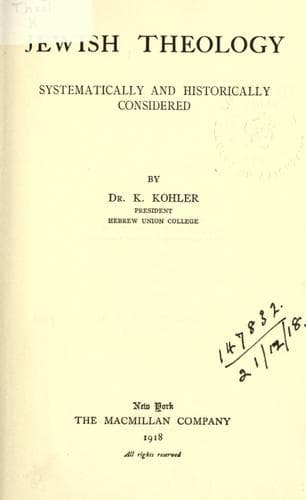
Jewish Theology, Systematically and Historically ConsideredKohler, Kaufmann
Religion
Jewish Theology, Systematically and Historically Considered
Kohler, Kaufmann
Judaism -- Doctrines
4. Biblical Judaism evinced such a powerful impetus toward a complete and
blissful life with God, that the center and purpose of existence could not
be transferred to the hereafter, as in other systems of belief, but was
found in the desire to work out the life here on earth to its fullest
possible development. Virtue and wisdom, righteousness and piety, signify
and secure true life; vice and folly, iniquity and sin, lead to death and
annihilation. This is the ever recurring burden of the popular as well as
of the prophetic and priestly wisdom of Israel.(893) In the song of thanks
of King Hezekiah after his recovery, the Jewish soul expresses itself,
when he says:(894) “I said, I shall not see the Lord, even the Lord in the
land of the living.... But Thou hast delivered my soul from the pit of
corruption. For the nether world cannot praise Thee; death cannot
celebrate Thee. The living, the living, he shall praise Thee, as I do this
day. The father to the children shall make known Thy truth.” Therefore the
author of the seventy-third Psalm, ennobled by trials, finds sufficient
comfort and happiness in the presence of God that he can spurn all earthly
treasures.(895) Job, too, in his affliction longed for death as release
from all earthly pain and sorrow, but not to bring him a state of rest and
peace like the Nirvana of the Indian beggar-monk, or an outlook into a
better world to come. Such an awakening to a new life seems to him
unthinkable,—although many commentators have often endeavored to read such
a hope into certain of his expressions.(896) Instead, his belief in God as
the Ruler of the infinite world, with His lofty moral purpose far
outreaching all human wisdom, lent him courage and power for further
effort and persistent striving on earth. Since to this suffering hero,
impelled to deeds by his own energy, life is a continuous battle, a
hereafter as a “world of reward and punishment” can hardly solve the great
enigma of human existence in a satisfactory manner for him. The wise
ones—says a Talmudic maxim—find rest neither in this world nor in the
world to come, but “they shall ascend from strength to strength, until
they appear before God on Zion.”(897)
Public-domain text, read in full here on John Shaqi.
Reviews
Reviews
No reviews yet
Be the first to share your thoughts on this work.
Elsewhere in the archive
Join the Discussion
Join the discussion
Sign in to leave a comment or review.
Sign InorCreate an account