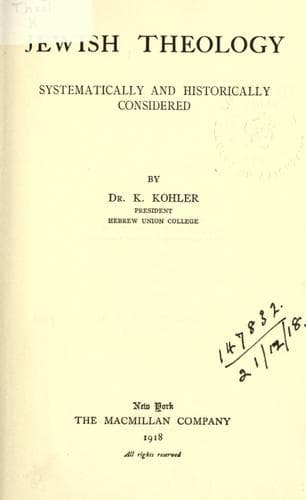
Jewish Theology, Systematically and Historically ConsideredKohler, Kaufmann
Religion
Jewish Theology, Systematically and Historically Considered
Kohler, Kaufmann
Judaism -- Doctrines
7. The founders of the liturgy of the Synagogue, in opposition to the
Sadducees, formulated therefore the belief in resurrection in the second
of the “Eighteen (or Seven) Benedictions” of the daily prayer in the
following words: “Thou, O Lord, art mighty forever. Thou revivest the
dead. Thou art mighty to save. Thou sustainest the living with
loving-kindness, revivest the dead with great mercy, supportest the
falling, healest the sick, loosest the bound, and keepest Thy faith to
them that sleep in the dust. (This refers to the Patriarchs, to whom God
has promised the land of the future.) Who is like unto Thee, O Lord of
mighty acts, and who resembleth Thee, O King, who killest and bringest to
life, and causest salvation to spring forth? Yea, faithful art Thou to
revive the dead. Blessed art Thou, O Lord, who revivest the dead.” In this
prayer dating from the age of the Maccabees(907) the Jewish consciousness
of two thousand years found a twofold hope,—the national and the
universally human. The national hope, which combined the belief in the
restoration of the kingdom of David and of the sacrificial cult with the
resurrection of the dead in the Holy Land, can be understood only in
connection with a historic view of Israel’s place in the world, and is
treated in the third part of this book. The purely human hope for the
continuity or the renewal of life rests on two fundamental problems which
must be examined more closely in the next two chapters. The one belongs to
the province of psychology and considers the question: What is the eternal
divine element in man? The other goes more deeply into the religious and
moral nature of man and considers the question: Where and how does divine
retribution—reward or punishment—take place in human life? To both of
these questions our modern view, with its special aim toward a unified
grasp of the totality of life, requires a special answer. This can be
neither that of rabbinic Judaism, which rests upon Persian dualism, nor
that of medieval philosophy, which was under the Platonic-Aristotelian
influence.
Chapter XLIV. The Immortal Soul of Man
Public-domain text, read in full here on John Shaqi.
Reviews
Reviews
No reviews yet
Be the first to share your thoughts on this work.
Elsewhere in the archive
Join the Discussion
Join the discussion
Sign in to leave a comment or review.
Sign InorCreate an account