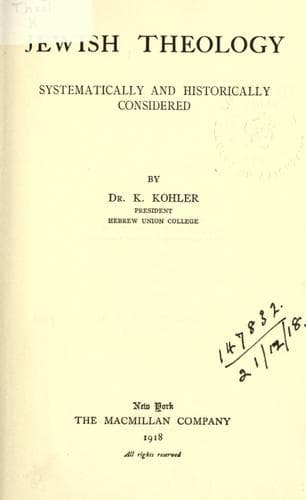
Jewish Theology, Systematically and Historically ConsideredKohler, Kaufmann
Religion
Jewish Theology, Systematically and Historically Considered
Kohler, Kaufmann
Judaism -- Doctrines
3. Man is a social being who must strike root in many spheres of life in
order that the variegated blossoms and fruits of his spiritual and
emotional nature may sprout forth. The more richly the communal life is
specialized into professions and occupations, the more does the province
of the individual expand, and the more difficult it is for him to attain
perfection on all sides. According to his faculties and predisposition he
must always develop one or the other side of human endeavor and pursue now
the beautiful, now the good, now the true and now the useful, if as the
image of God he is to emulate the Ideal of all existence, the Pattern of
all creation. Consequently he may reflect some radiance of the divine
glory in his character and achievements, whether as moral hero, as sage
and thinker, as statesman and battler for freedom, as artist, or as the
discoverer of new forces and new worlds; and yet the full splendor of
God’s greatness is mirrored only by mankind as a whole through its
ceaseless common action and interaction. Therefore Judaism deprecates
every attempt to present a single individual, be he ever so noble or wise,
as the ideal of all human perfection, as a perfect man, free from fault or
blemish. “There is none holy as the Lord, for there is none beside Thee,”
says Scripture.(993) Instead of extolling any single mortal as the type or
ideal of perfection, our sages rather say with reference to the lofty
characters of the Bible: “There is no generation which cannot show a man
with the love for righteousness of an Abraham, or the nobility of spirit
of a Moses, or the love for truth of a Samuel.”(994) That is to say, every
age creates its own heroes, who reflect the majesty of God in their own
way.
4. As man is the keystone of all creation, so he is called upon to take
his full share in the progress of the race. “He who formed the earth
created it not a waste; He formed it to be inhabited,” says the
prophet.(995) True humanity has its seat, not in the life of the recluse,
but in the family circle, amid mutual love and loyalty between husband and
wife, between parents and children. The sages, with their keen insight
into the spirit of the Scripture, point to the fact that it is man and
wife together who first receive the name of “man,” because only the mutual
helpfulness and influence, the care and toil for one another draw forth
the treasures of the soul, and create relations which warrant permanency
and give promise of a future.(996)
Public-domain text, read in full here on John Shaqi.
Reviews
Reviews
No reviews yet
Be the first to share your thoughts on this work.
Elsewhere in the archive
Join the Discussion
Join the discussion
Sign in to leave a comment or review.
Sign InorCreate an account