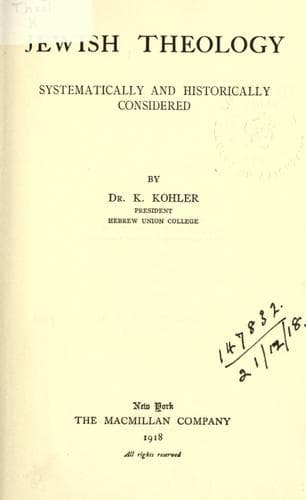
Jewish Theology, Systematically and Historically ConsideredKohler, Kaufmann
Religion
Jewish Theology, Systematically and Historically Considered
Kohler, Kaufmann
Judaism -- Doctrines
Chapter XLVII. The Moral Elements of Civilization
1. Because Judaism sees the attainment of human perfection only when the
divine in man has reached complete development through the unimpeded
activity of all his spiritual, moral, and social forces, it insists upon
the full recognition of all branches of human society as instruments of
man’s elevation, either individually or collectively. It deprecates the
idea that any force or faculty of human life be regarded as unholy and
therefore be suppressed. It thus rejects on principle monastic
renunciation and isolation, pointing to the Scriptural verse, “He who
formed the earth created it not a waste; He formed it to be
inhabited.(998)”
2. Accordingly Judaism regards the establishment of family life through
marriage as a duty obligatory on mankind, and sees in the entrance into
the marital relation an act of life’s supreme consecration. In contrast to
the celibacy sanctioned by the Church and approved by the rabbis only
under certain conditions, and exceptionally for their holy exercises by
the Essenes, the Tannaite R. Eliezer pronounces the man who through
bachelorhood shirks the duty of rearing children to be guilty of murder
against the human race. Another calls him a despoiler of the divine image.
Another rabbi says that such a one renounces his privilege of true
humanity, in so far as only in the married state can happiness, blessing,
and peace be attained.(999) It is significant as to the spirit of Judaism
that, while other religions regard the celibacy of the priests and saints
as signs of highest sanctity, the Jewish law expressly commands that the
high priest shall not be allowed to observe the solemn rites of the Day of
Atonement if unmarried.(1000) Love for the wife, the keeper and guardian
of the home, must attune his heart to tenderness and sympathy, if he is to
plead for the people before the Holy God. He can make intercession for the
household of Israel only if he himself has founded a family, in which are
practiced faithfulness and modesty, love and regard for the
life-companion, all the domestic virtues inherited from the past.
Public-domain text, read in full here on John Shaqi.
Reviews
Reviews
No reviews yet
Be the first to share your thoughts on this work.
Elsewhere in the archive
Join the Discussion
Join the discussion
Sign in to leave a comment or review.
Sign InorCreate an account