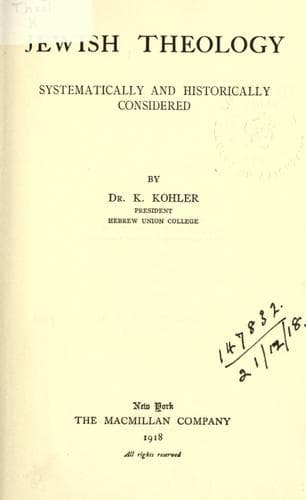
Jewish Theology, Systematically and Historically ConsideredKohler, Kaufmann
Religion
Jewish Theology, Systematically and Historically Considered
Kohler, Kaufmann
Judaism -- Doctrines
4. The belief in the election of Israel rests on the conviction that the
Jewish people has a certain superiority over other peoples in being
especially qualified to be the messenger and champion of religious truth.
In one sense this prerogative takes into account every people which has
contributed something unique to any department of human power or
knowledge, and therein has served others as pattern and guide. From the
broader standpoint, all great historic peoples appear as though appointed
by divine providence for their special cultural tasks, in which others can
at most emulate them without achieving their greatness. Yet we cannot
speak in quite the same way of the election of the Greeks or Romans or of
the nations of remote antiquity for mastery in art and science, or for
skill in jurisprudence and statecraft. The fact is that these nations were
never fully conscious that they had a historic or providential destiny to
influence mankind in this special direction. Israel alone was
self-conscious, realizing its task as harbinger and defender of its
religious truth as soon as it had entered into its possession. Its
election, therefore, does not imply presumption, but rather a grave duty
and responsibility. As the great seer of the Captivity had already
declared, to be the servant of the Lord is to undergo the destiny of
suffering, to be “the man of sorrow,” from whose bruises comes healing
unto all mankind.(1030)
5. Accordingly the election of Israel cannot be regarded as a single
divine act, concluded at one moment of revelation, or even during the
Biblical period. It must instead be considered a divine call persisting
through all ages and encompassing all lands, a continuous activity of the
spirit which has ever summoned for itself new heralds and heroes to
testify to truth, justice, and sublime faith, with an unparalleled scorn
for death, and to work for their dissemination by words and deeds and by
their whole life. Judaism differs from all other religions in that it is
neither the creation of one great moral teacher and preacher of truth, nor
seeks to typify the moral and spiritual sublimity which it aims to develop
in a single person, who is then lifted up into the realm of the
superhuman. Judaism counts its prophets, its sages, and its martyrs by
generations; it is still demonstrating its power to reshape and regenerate
religion as a vital force. Moreover, Judaism does not separate religion
from life, so as to regard only a segment of the common life and the
national existence as holy. The entire people, the entire life, must bear
the stamp of holiness and be filled with priestly consecration. Whether
this lofty aim can ever be completely attained is a question not to be
decided by short-sighted humanity, but only by God, the Ruler of history.
It is sufficient that the life of the individual as well as that of the
people should aspire toward this ideal.
Public-domain text, read in full here on John Shaqi.
Reviews
Reviews
No reviews yet
Be the first to share your thoughts on this work.
Elsewhere in the archive
Join the Discussion
Join the discussion
Sign in to leave a comment or review.
Sign InorCreate an account