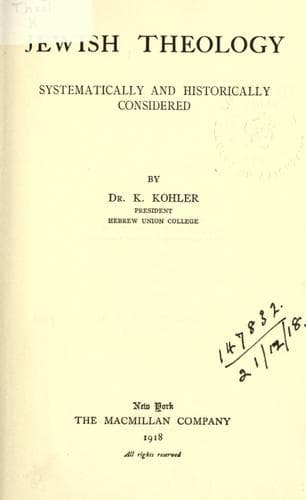
Jewish Theology, Systematically and Historically ConsideredKohler, Kaufmann
Religion
Jewish Theology, Systematically and Historically Considered
Kohler, Kaufmann
Judaism -- Doctrines
7. All these and similar sayings disprove completely the idea that the
election of Israel was an arbitrary act of God. It is due rather to
hereditary virtues and to tendencies of mind and spirit which equip Israel
for his calling. To this must be added the important fact that God
educated the people for its task through the Law, which was to make it
conscious of its priestly sanctity and keep it ever active in mind and
heart. The election of Israel is emphasized in Deuteronomy especially in
connection with the prohibition of marriage with idolaters and with the
prohibition of unclean animals, which also originated in the priestly
laws.(1038) The underlying idea is that the mission of Israel to battle
for the Most High imperatively demands separation from the heathen
peoples, and on the other hand, that its priestly calling necessitates an
especial abstinence. And as has the law in its development and realization
for thousands of years, so has also God’s wise guidance trained Israel in
the course of history so as to render him at times the unyielding
preserver and defender and at other times the bold champion and
protagonist of the highest truth and justice, according as the outlook and
the mental horizon of the period were narrow or broad.
8. It is true that the thought of Israel’s calling and mission in
world-history first became clear when its prophets and sages attained a
view of great world-movements from the lofty watch-tower of the centuries,
so that they could take cognizance of the varying relations of Judaism to
the civilized peoples around. The summons of the Jewish people to be
heralds of truth and workers for peace is first mentioned in Isaiah and
Micah,(1039) while only in the great movement of nations under Cyrus did
the seer of the Exile recognize the peculiar mission of Israel in the
history of the world. If in gloomy periods the outlook became dark, still
the hope for the fulfillment of this mission was never entirely lost. In
fact, the contact of the Jewish people with Greek culture after Alexander
the Great gave new power and fresh impetus to the conception of Israel’s
mission,(1040) as the rich Hellenistic literature and the vision of Daniel
in chapter VII testify. In fact, Abraham, the ancestor of the Jewish
people, became for the earliest Haggadists a wandering missionary and a
great preacher of the unity of God, and his picture was the pattern for
both Paul and Mohammed.(1041) The election of Israel is clearly and
unequivocally expressed by Rabbi Eleazar ben Pedath in the words, “God
sent Israel among the heathen nations that they may win a rich harvest of
proselytes, for, as God said through Hosea, ‘I will sow her unto Me in the
land,’ so He wishes from this seed to reap a bountiful and world-wide
harvest.”(1042)
Public-domain text, read in full here on John Shaqi.
Reviews
Reviews
No reviews yet
Be the first to share your thoughts on this work.
Elsewhere in the archive
Join the Discussion
Join the discussion
Sign in to leave a comment or review.
Sign InorCreate an account