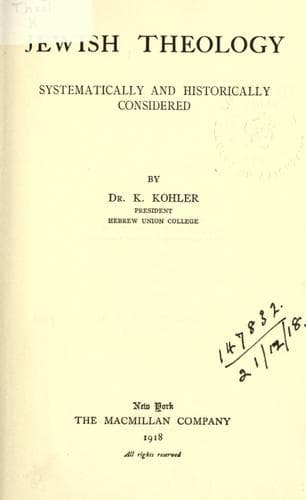
Jewish Theology, Systematically and Historically ConsideredKohler, Kaufmann
Religion
Jewish Theology, Systematically and Historically Considered
Kohler, Kaufmann
Judaism -- Doctrines
8. It is true that the accumulation of “law upon law, prohibition upon
prohibition” by the rabbis had eventually the same injurious effect which
it had exerted upon the priests in the Temple. The formal law, “the
precepts learned by rote,” became the important factor, while their
purpose was lost to sight. The shell smothered the kernel, and blind
obedience to the letter of the law came to be regarded as true piety. It
cannot be denied that adherence to the mere form, which was transmitted
from the Temple practice to the legalism of the Pharisees and the later
rabbinic schools with their casuistry, impaired and tarnished the lofty
prophetic ideal of holiness. It almost seems as if the clarion notes of
such sublime passages as that of the Psalmist,
“Who shall ascend into the mountain of the Lord,
And who shall stand in His holy place?
He that hath clean hands and a pure heart;
Who hath not taken My name in vain, and hath not sworn
deceitfully,”(1128)
no longer found its full resonance in the heart of Judaism. In the
practice of external acts of piety religion became petrified and the
spirit took flight. That which is of secondary importance became of
primary consideration. This is the fundamental error into which the
practice and the development of the Law in Judaism lapsed, and to which no
careful observer can or dares close his eyes. Undoubtedly the Law, as it
embraced the whole of life in its power, sharpened the Jewish sense of
duty, and served the Jew as an iron wall of defense against temptations,
aberrations, and enticements of the centuries. As soon as the modern Jew,
however, undertook to free himself from the tutelage of a blind acceptance
of authority and inquired after the purpose of all the restrictions which
the Law laid upon him, his ancient loyalty to the same collapsed and the
pillars of Judaism seemed to be shaken. Then the leaders of Reform, imbued
with the prophetic spirit, felt it to be their imperative duty to search
out the fundamental ideas of the priestly law of holiness, and,
accordingly, they learned how to separate the kernel from the shell. In
opposition to the orthodox tendency to worship the letter, they insisted
on the fact that Israel’s separation from the world—which it is ultimately
to win for the divine truth—cannot itself be its end and aim, and that
blind obedience to the law does not constitute true piety. Only the
fundamental idea, that Israel as the “first-born” among the nations has
been elected as a priest-people, must remain our imperishable truth, a
truth to which the centuries of history bear witness by showing that it
has given its life-blood as a ransom for humanity, and is ever bringing
new sacrifices for its cause.
Public-domain text, read in full here on John Shaqi.
Reviews
Reviews
No reviews yet
Be the first to share your thoughts on this work.
Elsewhere in the archive
Join the Discussion
Join the discussion
Sign in to leave a comment or review.
Sign InorCreate an account