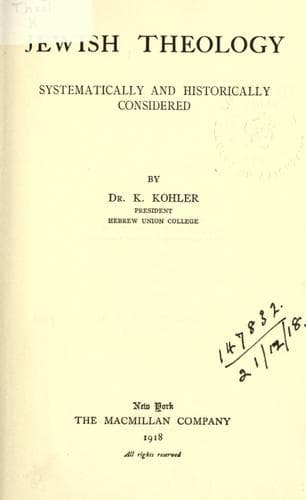
Jewish Theology, Systematically and Historically ConsideredKohler, Kaufmann
Religion
Jewish Theology, Systematically and Historically Considered
Kohler, Kaufmann
Judaism -- Doctrines
5. It was, however, no easy matter for men reared in the old view to reach
the lofty conception of a suffering hero. Even the dramatic figure of Job
seemed to lack the right solution. Job protests his guiltlessness, defies
the dark power of fate, and even challenges divine justice, but God
himself announces at the end that no man can grasp the essence of His plan
for the world. A later and more naïve writer, who added the conclusion of
the book, reversed Job’s destiny and compensated him by a double share of
what he had lost in both wealth and family.(1185) As if the great problem
of suffering could be solved by such external means! Neither would the
problem of the great tragedy of Israel, the martyr-priest of the
centuries, the Job of the nations, ever find its solution in a national
restoration. A mere political rebirth could never compensate for the
thousandfold death and untold woe of the Jew for his God and his faith!
But the people at large could not grasp such a conception as is that of
Deutero-Isaiah’s of the mission of Israel to be the suffering servant of
the Lord, the witness of God—which is “martyr” in the Greek version,—the
redeemer of the nations. They were eager to return to Palestine, to
rebuild State and Temple under the leadership of the heir to the throne of
David. But when their hope had failed that Zerubbabel would prove to be
the “shoot of Jesse,”(1186) the prophetic elegy was referred to the
Messiah, and the belief gained ground that he would have to suffer before
he would triumph.(1187) Thus many a pseudo-Messiah fell a victim to the
tyranny of Rome in both Judæa and Samaria,—for the Samaritans also hoped
for a Messiah, a redeemer of the type of Moses.(1188) Finally a belief
arose that there would be two Messiahs, one of the house of Joseph, that
is, the tribe of Ephraim, who would fall before the sword of the
enemy,(1189) and the other of the house of David, who was to conquer the
heathen nations and establish his throne forever.(1190)
The Church referred the pathetic figure of the man of sorrow to her
crucified Messiah or Christ. Yet he who was to be a world-savior bore
through his followers damnation to his own kinsmen, and thus was rendered
the chief cause of the persecution of the martyr-race of Israel.
Public-domain text, read in full here on John Shaqi.
Reviews
Reviews
No reviews yet
Be the first to share your thoughts on this work.
Elsewhere in the archive
Join the Discussion
Join the discussion
Sign in to leave a comment or review.
Sign InorCreate an account