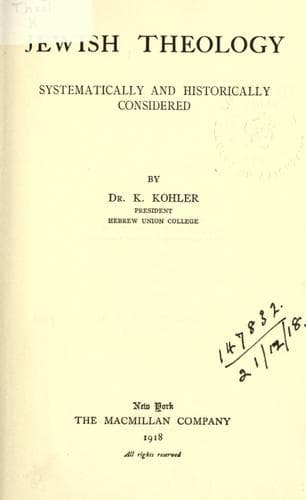
Jewish Theology, Systematically and Historically ConsideredKohler, Kaufmann
Religion
Jewish Theology, Systematically and Historically Considered
Kohler, Kaufmann
Judaism -- Doctrines
The prominence of the full proselyte in the early Synagogue appears in the
ancient benediction for the righteous leaders and Hasidim, the Soferim and
Synedrion, the ruling authorities of the Jewish nation, where special
mention is made of “the Proselytes of (the) Righteousness.”(1322) These
full proselytes pushed aside the half-proselytes, so that, while both are
mentioned in the earlier classification, only the latter are considered by
the later Haggadah.(1323) With the dissolution of the Jewish State no
juridical basis remained for the _Ger Toshab_, the “protected stranger.”
R. Simeon ben Eleazar expressed this in the statement: “With the cessation
of the Jubilee year there was no longer any place for the _Ger Toshab_ in
Judæa.”(1324) We read in Josephus that no proselytes were accepted in his
time unless they submitted to the Abrahamitic rite and became full
proselytes.(1325)
However, as Josephus tells us, a strong desire to espouse the Jewish faith
existed among the pagan women of neighboring countries, especially of
Syria.(1326) The same situation existed in Rome according to the
rabbinical sources, Josephus, Roman writers, and many tomb
inscriptions.(1327) Conspicuous among these proselytes was Queen Helen of
Adiabene, who won lasting fame by her generous gifts to the Jewish people
in time of famine and to the Temple at Jerusalem; her son Menobaz, at the
advice of a Jewish teacher, underwent the rite of circumcision in order to
rise from a mere God-worshiper to a full proselyte.(1328) The
Midrash(1329) enumerates nine heathen women of the Bible who became
God-worshipers: Hagar; Asenath, the wife of Joseph, whose conversion is
described in a little known but very instructive Apocryphal book by that
name;(1330) Zipporah, the wife of Moses; Shifra and Puah, the Egyptian
midwives;(1331) Pharaoh’s daughter, the foster-mother of Moses, whom the
rabbis identified with Bithia (_Bath Yah_, “Daughter of the Lord”);(1332)
Rahab, whom the Midrash represents as the wife of Joshua and ancestress of
many prophets;(1333) Ruth and Jael. Philo adds Tamar, the daughter-in-law
of Judah, as a type of a proselyte.(1334)
Public-domain text, read in full here on John Shaqi.
Reviews
Reviews
No reviews yet
Be the first to share your thoughts on this work.
Elsewhere in the archive
Join the Discussion
Join the discussion
Sign in to leave a comment or review.
Sign InorCreate an account