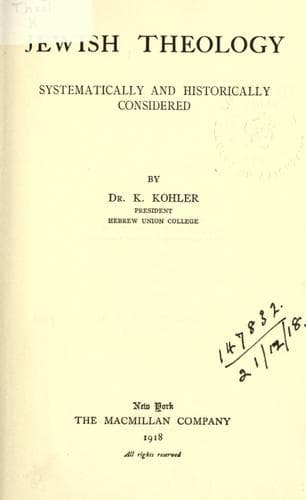
Jewish Theology, Systematically and Historically ConsideredKohler, Kaufmann
Religion
Jewish Theology, Systematically and Historically Considered
Kohler, Kaufmann
Judaism -- Doctrines
9. The school of Hillel followed in the footsteps of Hellenistic Judaism
in accentuating the ethical element in the law;(1342) so naturally it
encouraged proselytism as well. The Midrash preserves the following
Mishnah, handed down by Simeon ben Gamaliel, but not contained in our
Mishnaic Code: “If a _Ger_ desires to espouse the Jewish faith, we extend
to him the hand of welcome in order to bring him under the wings of the
Shekinah.”(1343) Both the Midrash and the early Church literature reveal
traces of a Jewish treatise on proselytes, containing rules for admission
into the two grades, which was written in the spirit of the Hellenistic
propaganda, but was afterward rewritten and adopted by the Christian
Church. The school of Shammai in its rigorous legalism opposed proselytism
in general, and its chief representative, Eliezer ben Hyrcanos, distrusted
proselytes altogether.(1344) On the other hand, the followers of Hillel
were decidedly in favor of converting the heathen and were probably
responsible for many Haggadic passages extolling the proselytes. Thus the
verse of Deutero-Isaiah: “One shall say, ‘I am the Lord’s,’ and another
shall call himself by the name of Jacob; and another shall subscribe with
his hand unto the Lord, and surname himself by the name of Israel” is
peculiarly applied in the Midrash. The first half, we are told, denotes
two classes of Israelites, those who are without blemish, and those who
have sinned and repented; the second half includes the two classes of
proselytes, those who have become full Jews (_Gere ha Zedek_) and those
who are merely worshippers of God (_Yir’e Shamayim_). A later Haggadic
version characteristically omits the last, recognizing only the full
converts (_Gere Emeth_) as proselytes.(1345) The following parable in the
spirit of the Essenes illustrates their viewpoint. In commenting upon the
verse from the Psalms: “The Lord keepeth the strangers,” the story is
told: A king possessed a flock of sheep and goats and noted that a deer
joined them, accompanying them to their pasture and returning with them.
So he said to the herdsmen: “Take good care of this deer of mine which has
left the free and broad desert to go in and out with my flock, and do not
let it suffer hunger or thirst.” Likewise God takes special delight in the
proselytes who leave their own nation, giving up their fellowship with the
great multitude in order to worship Him as the One and Only God, together
with the little people of Israel.(1346) Similarly the Biblical verse
concerning wisdom: “I love them that love me, and those that seek me
earnestly shall find me”(1347) is referred to the proselytes, “who give up
their entire past from pure love of God, and place their lives under the
sheltering wings of the divine majesty.” All these Midrashic passages and
many others are but feeble echoes of the conceptions of the Hellenistic
propaganda, which were so ably set forth by Philo and the Book of Asenath.
Public-domain text, read in full here on John Shaqi.
Reviews
Reviews
No reviews yet
Be the first to share your thoughts on this work.
Elsewhere in the archive
Join the Discussion
Join the discussion
Sign in to leave a comment or review.
Sign InorCreate an account