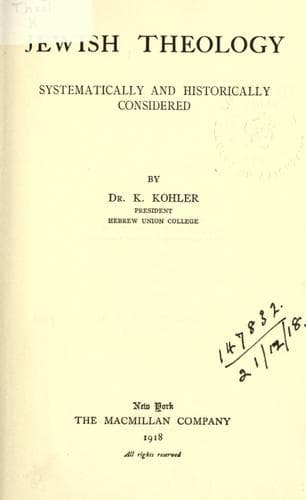
Jewish Theology, Systematically and Historically ConsideredKohler, Kaufmann
Religion
Jewish Theology, Systematically and Historically Considered
Kohler, Kaufmann
Judaism -- Doctrines
Thus he was forced to flee to the Jewish colony of Yathrib, afterwards
called Medina, “the city” of the prophet. He hoped for recognition there,
especially after he had made certain concessions, such as turning the face
toward Jerusalem in prayer, and keeping the Day of Atonement on the tenth
of Tishri. In addition, he emphasized the unity of God in the strongest
possible manner, and opposed every encroachment upon it by the belief in
additional powers or persons, attacking the Christians on the one hand and
his Arabian countrymen on the other, with the sarcastic phrase: “Verily,
God has neither a son, nor has He any daughter.” In spite of all these
facts, the Jews could not be brought to recognize the uneducated son of
the desert as a prophet. Therefore his proffered friendship was turned to
deadly hatred and passionate revenge. His whole nature underwent a great
change; his former enthusiasm and prophetic zeal were replaced by
calculation and worldly desire, so that the preacher of repentance of
Mecca became at the last a lover of bloodshed, robbery and lust. Instead
of Jerusalem he chose Mecca with its heathen traditions as the center of
his religious system and aimed chiefly to win the Arabian tribes for his
divine revelation.
Thus the entire Arabian nation, full of youthful energy, burning with the
impulse of great deeds, bore the faith of the One God to the world by the
sword. Like Israel of old, it stepped forth from the desert with a divine
revelation contained in a holy book. It conquered first the Christian
lands of the East, which under the Trinitarian dogma had lapsed from pure
monotheism, then the northern coast of Africa, and it finally unfurled the
green flag of Islam over the lands of the West to free them from the
fanatical Church. Henceforth war was waged for centuries between the One
God of Abraham and the triune God of the Church in both Spain and
Palestine. Then might the genius of history ask: “Watchman, what of the
night? Watchman, what of the night?” And again the words are heard, as
from on high: “The morning cometh, and also the night.” The final victory
is yet to come.
Public-domain text, read in full here on John Shaqi.
Reviews
Reviews
No reviews yet
Be the first to share your thoughts on this work.
Elsewhere in the archive
Join the Discussion
Join the discussion
Sign in to leave a comment or review.
Sign InorCreate an account