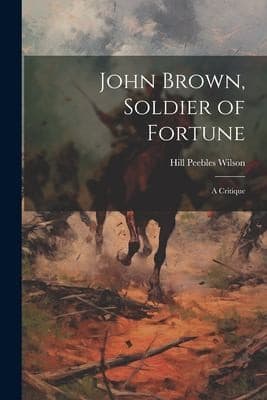
John Brown, Soldier of Fortune: A CritiqueWilson, Hill Peebles
History
John Brown, Soldier of Fortune: A Critique
Wilson, Hill Peebles
Brown, John, 1800-1859
The foregoing is the record, to date, of John Brown's "activities" in
Kansas. The peace and tranquility of the Osawatomie district to which he
came in October, 1855, had not theretofore been disturbed by any
distracting contentions. The settlers were pursuing the even tenor of
their way. They were comfortable, prosperous, and contented; living in
the security vouchsafed, by the usages of our civilization and the laws
of our country, to all of its citizens. They so continued to live,
during a period of eight months thereafter, wholly unsuspicious of the
designs their neighbor, Brown, was maturing against their peace, their
property, and their lives.
From 1854 to 1860, the great political contest in the country was over
the question of the extension of slavery into the public domain. It was
the paramount issue in National politics. New alignments were then
formed throughout the country in relation to it, as men were differently
moved by their sympathies or interests. In Kansas, the division in
public sentiment was more pronounced than elsewhere, for reasons that
have been stated. Naturally, the settlers in the Osawatomie neighborhood
were divided upon this political question; but certainly not with very
much greater intensity of feeling than this same neighborhood was
divided afterward, upon the great moral question of prohibition, or upon
the equally great economic question of free-coinage of silver. The
differences of opinion there did not promote or arouse personal
animosities, or bitterness of feeling, among the settlers. Ample
authority for this conclusion of fact is found in the letters written,
at the time, by John Brown and others of his family, and in the
statement which he voluntarily made in 1857, before a committee of the
Massachusetts legislature, heretofore quoted. A large majority of the
settlers in that district belonged to the Free-State party which made
the security and peace of the Free-State settlers complete, beyond
debate. These conditions of peace and tranquility continued undisturbed,
until the night of May 24, 1856, when John Brown opened his "school" of
plunder, and cast the baleful shadow of his presence upon the
settlement. The Pottawatomie horror inaugurated a season of
assassination and robbery unprecedented in Kansas history: a period of
public disorder and crime, that ended only when the Territory was
finally rid of John Brown and his marauders.
CHAPTER VIII
HYPOCRISY
_He was a man
Who stole the livery of the court of Heaven
To serve the Devil in._
--POLLOCK, COURSE OF TIME
Public-domain text, read in full here on John Shaqi.
Reviews
Reviews
No reviews yet
Be the first to share your thoughts on this work.
Elsewhere in the archive
Join the Discussion
Join the discussion
Sign in to leave a comment or review.
Sign InorCreate an account