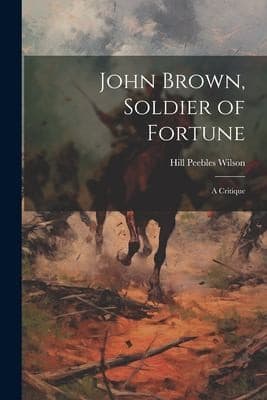
John Brown, Soldier of Fortune: A CritiqueWilson, Hill Peebles
History
John Brown, Soldier of Fortune: A Critique
Wilson, Hill Peebles
Brown, John, 1800-1859
"On or about the 30th of May, two of my sons, with several
others, were imprisoned without other crime than opposition
to bogus legislation, and most barbarously treated for a
time, one being held about one month, and the other about
four months. Both had their families on the ground. After
this, both of them had their houses burned, and all their
goods consumed by the Missourians. In this burning all the
eight suffered. One had his oxen stolen, in addition."
The Captain, laying aside his paper, here said that he had
now at his hotel, and would exhibit to the Committee, if
they so desired, the chains which one of his sons had worn,
when he was driven beneath the burning sun, by federal
troops, to a distant prison, on a charge of treason. The
cruelties he there endured, added to the anxieties and
sufferings incident to his position, had rendered him, the
old man said, as his eye flashed and his voice grew
sterner, "A maniac--yes, a MANIAC."
He paused a few seconds, wiped a tear from his eye, and
continued his narration....
"I saw while it was standing, and afterwards saw the ruins,
of a most valuable house, the property of a highly
civilized, intelligent, and exemplary Christian Indian,
which was burned to the ground by the ruffians, because its
owner was suspected of favoring the free state men. He is
known as Ottawa Jones, or John T. Jones.
"In September last, I visited a beautiful little free state
town called Staunton, on the north side of the Osage, (or
Marais-des-Cygnes, as it is sometimes called,) from which
every inhabitant had fled for fear of their lives, even
after having built a strong log house, or wooden fort, at a
heavy expense, for their protection. Many of them had left
their effects liable to be destroyed or carried off, not
being able to remove them. This was to me a most gloomy
scene, and like a visit to a sepulchre.
"About the first of September, I, and five sick and wounded
sons, and a son-in-law, were obliged to lie on the ground,
without shelter, for a considerable time, and at times
almost in a state of starvation, and dependent on the
charity of the Christian Indian I have named before, and
his wife."
Public-domain text, read in full here on John Shaqi.
Reviews
Reviews
No reviews yet
Be the first to share your thoughts on this work.
Elsewhere in the archive
Join the Discussion
Join the discussion
Sign in to leave a comment or review.
Sign InorCreate an account