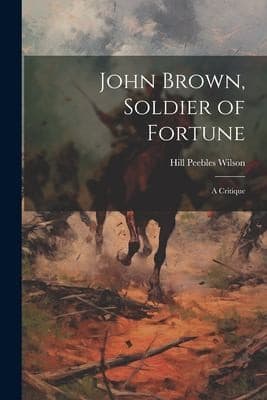
John Brown, Soldier of Fortune: A CritiqueWilson, Hill Peebles
History
John Brown, Soldier of Fortune: A Critique
Wilson, Hill Peebles
Brown, John, 1800-1859
It is inconsistent with the tenor of this letter, to draw from it the
conclusion that the "mighty conquest" was a profitless "foray," or a
"raid," that Brown thus invited Mr. Sanborn to engage in; nor did the
latter so understand it. On the contrary he took the proposal seriously,
and was deeply impressed with the broad significance of the undertaking
herein dimly foreshadowed. Commenting thereon he, consistently, said:
Till I follow my noble friend to the other world, on which
his hopes were fixed, I can never read this letter without
emotion. Yet it did not persuade me to comply with his
wish. Long accustomed to guide my life by leadings and
omens from that shrine whose oracles may destroy but can
never deceive, I listened in vain, through months of doubt
and anxiety, for a clear and certain call. But it was
revealed to me that no confidence could be too great, no
trust or affection too extreme toward this aged, poor man
whom the Lord had chosen as his champion.
One might venture to suggest, in this connection, that Mr. Sanborn's
failure to catch any note of a "clear and certain call" during his
months of doubt and anxiety, might be due, possibly, to facts or
conditions existing in the Omnipotent economy. God, "whose mercy
endureth forever," may not have desired that a "generation should pass
off the face of the earth," at that time, "by a violent death." Also,
the absence of any evidence of the Divine approval of Brown's scheme,
raises a question of doubt, that the Lord had really appointed "this
aged poor man as his chosen champion." While, on the other hand, the
lamentable failure of the expedition undertaken in the accomplishment of
this enterprise; and the overwhelming wreck and ruin of those who
engaged in it, point to the theory that God, if he took any active
participation in the matter at all, was opposed to Brown--that he was on
the other side--on the side of the generation of men, women, and
children, who, trusting in His mercy, lived in innocent ignorance of
Brown's plot to destroy them.
Public-domain text, read in full here on John Shaqi.
Reviews
Reviews
No reviews yet
Be the first to share your thoughts on this work.
Elsewhere in the archive
Join the Discussion
Join the discussion
Sign in to leave a comment or review.
Sign InorCreate an account