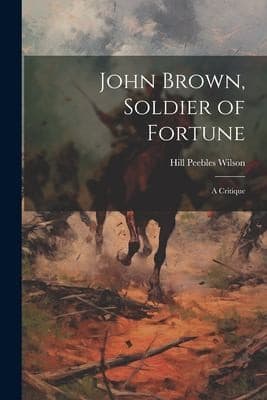
John Brown, Soldier of Fortune: A CritiqueWilson, Hill Peebles
History
John Brown, Soldier of Fortune: A Critique
Wilson, Hill Peebles
Brown, John, 1800-1859
They did not give anything back. Brown said to me that we
might get our property if we could; that he defied us and
the whole United States to follow him. He and his men
seemed anxious to take more from me than they did for they
ransacked the house in search of money, and I suppose they
would have taken it if they had found it.... What I have
stated is the truth and I am willing to swear to it. I do
not hold any particular malice or prejudice on account of
these old transactions. Old things have passed away, but
the truth can never pass away.[333]
Along with the plunder of the Hicklan home, five slaves were taken;
these are said to have belonged to the "Lawrence estate" then in
Hicklan's care, as administrator. Besides the negroes, he took from the
Lawrence estate two good horses, a yoke of oxen, a good wagon, harness,
saddles, a considerable quantity of provisions, bacon, flour, meal,
coffee, sugar, etc.; all of the bedding and clothing of the negroes,
Hicklan's shot-gun, overcoat, boots, and many other articles belonging
to the whites. From Larue were taken five negroes, six head of horses,
harness, a wagon, a lot of bedding and clothing, provisions, and, in
short, all the loot available and portable.[334] Besides killing Cruise
and looting the home, Stevens took, as claimed by the family, two yoke
of oxen, a wagon load of provisions, eleven mules, and two horses. A
mule was also taken from the Hugh Martin home.
After the robberies the two parties united at a point theretofore agreed
upon, and started on the return trip to Kansas. At daylight they
secreted themselves in a deep wooded ravine, where they remained until
after dark, when they continued their march, arriving at Mr. Wattles's
home, two miles north of Mound City, at midnight of Wednesday the 22d.
Here Brown stopped until morning, having with him the slaves, one wagon,
and two or three of his men; the others pushing on northward with the
swag, to get it beyond danger of recovery, and to divide it or sell it
for the benefit of all concerned.
The liberation of the slaves was a cumbersome and dangerous experiment,
but it was as necessary as it was dangerous. To have taken all this
plunder and carried it off without the diversion of taking the slaves
with him, would have been a case of such plain stealing, that Brown
would have been completely discredited therefor; even the "Secret War
Committee" might have joined in the general repudiation of him that
would have followed. But the carrying off of the slaves to freedom, in
this wholesale spectacular way, was great advertising; it distracted
attention from the basic motive of the raid, and secured creditable
notoriety for Brown in the North. It seems, however, that after arriving
at the Wattles home with the slaves, Brown practically, or personally at
least, abandoned them to their fate. The narrative states:[335]
Public-domain text, read in full here on John Shaqi.
Reviews
Reviews
No reviews yet
Be the first to share your thoughts on this work.
Elsewhere in the archive
Join the Discussion
Join the discussion
Sign in to leave a comment or review.
Sign InorCreate an account