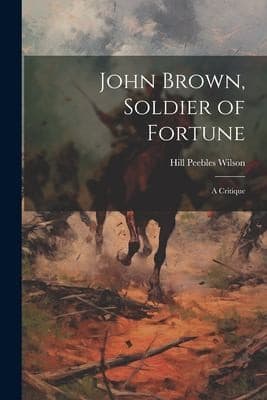
John Brown, Soldier of Fortune: A CritiqueWilson, Hill Peebles
History
John Brown, Soldier of Fortune: A Critique
Wilson, Hill Peebles
Brown, John, 1800-1859
Pending the sale of the plunder and final settlement for it, Brown
remained an unwelcome prowler, in the neighborhood of Moneka, amid a
storm of indignation against him that was as general as it was severe.
Even his "staunch friend Wattles" severely censured him "for going into
Missouri, contrary to our agreement, and getting these slaves." On
January 2d, Brown wrote a formal letter to Montgomery "asking him to
hold himself in readiness to call out reënforcements at a moment's
notice, to prevent a possible invasion because of a raid into Missouri."
But Montgomery was not holding himself in readiness to defend Brown, or
to repel the retaliatory invasion he had invited; but "was eagerly at
work for peace;" seeking to prevent a retaliatory blow from falling
upon the Free-State settlement. What Montgomery wrote to Brown in reply
to this letter, if he answered it at all, has never been published. He
denied having any complicity with Brown, and joined in the general
denunciation of him, and in the condemnation of his action. It was this
denunciation of him by Montgomery and the Free-State men generally that
called forth Brown's personal defense of his conduct, in what he called
his "Parallels"; a paper conspicuous in Brown literature.
The Lawrence _Herald of Freedom_ on January 8, 1859, published a letter
from a clergyman at Moneka, from which the following paragraphs are
extracts:[338]
I have watched the progress of these troubles here until I
am sick-heart-sick with humanity. Here are men claiming to
be Christians, and even ministers of the Gospel, who
profess to be guided in their actions by the teachings of
the Prince of Peace, who have organized a body of
murderers, robbers, gamblers and horse-thieves, and
subsisting by plunder. They are riding over the country and
committing the basest of crimes. If this is Christianity
anything would be preferable to it.
The strangest of all is to see peace men, those in the
States who were members of peace societies, and who were
sending delegates to peace congresses, laboring to
inaugurate civil war, with the expressed object of working
a revolution throughout the nation, ultimating in a
dissolution of the Union; and all to procure the
emancipation of the slave. Simple men! They should learn
that revolutions involving such grave consequences are not
usually set on foot by murderers and thieves. Though Brutus
triumphed over the dead corpse of Cæsar, yet it is not
believed that in this age of enlightment a few ignoramuses
and desperadoes of the character of those in this country
can succeed in crushing out slavery and with it American
freedom.
Public-domain text, read in full here on John Shaqi.
Reviews
Reviews
No reviews yet
Be the first to share your thoughts on this work.
Elsewhere in the archive
Join the Discussion
Join the discussion
Sign in to leave a comment or review.
Sign InorCreate an account