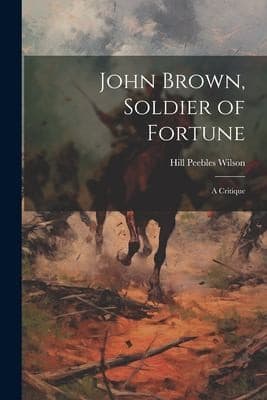
John Brown, Soldier of Fortune: A CritiqueWilson, Hill Peebles
History
John Brown, Soldier of Fortune: A Critique
Wilson, Hill Peebles
Brown, John, 1800-1859
_A Bystander._ That is not so. You killed an unarmed man at
the corner of the house over there at the water-tank, and
another besides.
_Brown._ See here, my friend; it is useless to dispute or
contradict the report of your own neighbors who were my
prisoners.
* * * * *
_Mr. Vallandigham (who had just entered.)_ Mr. Brown, who
sent you here?
_Brown._ No man sent me here; it was my own prompting and
that of my Maker, or that of the Devil--whichever you
please to ascribe it to. I acknowledge no master in human
form.
* * * * *
_Vallandigham._ Did you get up this document that is called
a Constitution?
_Brown._ I did. They are a constitution and ordinance of my
own striving and getting up.
_Vallandigham._ How long have you been engaged in this
business?
_Brown._ From the breaking out of the difficulties in
Kansas. Four of my sons had gone there to settle, and they
induced me to go. I did not go there to settle, but because
of the difficulties.
* * * * *
_Mason._ What was your object in coming?
_Brown._ We came to free the slaves, and only that.
* * * * *
_A Volunteer._ What in the world did you suppose you could
do here in Virginia with that amount of men?
_Brown._ Young man, I do not wish to discuss that question
here.
_Volunteer._ You could not do anything.
_Brown._ Well, perhaps your ideas and mine on military
subjects would differ materially.
* * * * *
_Mason._ Did you consider this a military organization in
this Constitution? I have not yet read it.
_Brown._ I did in some sense. I wish you would give that
paper close attention.
_Mason._ You consider yourself the commander-in-chief of
these "provisional" military forces?
_Brown._ I was chosen, agreeably to the ordinance of a
certain document, commander-in-chief of that force.
_Mason._ What wages did you offer?
_Brown._ None.
_Stuart._ "The wages of sin is death."
_Brown._ I would not have made such a remark to you if you
had been a prisoner, and wounded, in my hands.
* * * * *
_A Bystander._ Do you consider this a religious movement?
_Brown._ It is, in my opinion, the greatest service man can
render to God.
_Bystander._ Do you consider yourself an instrument in the
hands of Providence?
_Brown._ I do.
_Bystander._ Upon what principle do you justify your acts?
Public-domain text, read in full here on John Shaqi.
Reviews
Reviews
No reviews yet
Be the first to share your thoughts on this work.
Elsewhere in the archive
Join the Discussion
Join the discussion
Sign in to leave a comment or review.
Sign InorCreate an account