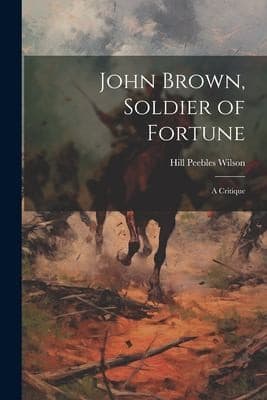
John Brown, Soldier of Fortune: A CritiqueWilson, Hill Peebles
History
John Brown, Soldier of Fortune: A Critique
Wilson, Hill Peebles
Brown, John, 1800-1859
In his statement of the facts as to the happenings on the Pottawatomie,
Mr. Villard makes one sole reference to the robberies that happened. It
is, that when Owen Brown had been denounced by his uncle, the Rev. Mr.
Adair of Osawatomie, on the 26th, as a "vile murderer," and was refused
admission to his home, that "he rode away on one of the murdered men's
horses." Except for this and another incidental reference to theft, the
reader of _Fifty Years After_ would not be informed that any robbery had
been committed; and even this statement is artfully written. It is
incorrect and misleading. It conceals a thread in this history which
would, if exposed, unmask the selfishness that prompted this crime: Owen
Brown rode away on one of the "fast Kentucky horses" which John Brown
received _in exchange_ for the "murdered men's horses."
Mr. Villard assumes that Brown's motives for committing the murders
herein, and stealing these horses, were unselfish; a grace that should
logically apply to the swaggering, swearing infidels whom he directed.
In a summary of his conclusions he says:[154]
Fired with indignation at the wrongs he witnessed on every
hand, impelled by the Covenanter's spirit that made him so
strange a figure in the nineteenth century, and believing
fully that there should be an eye for an eye and a tooth
for a tooth, he killed his men in the conscientious belief
that he was a faithful servant of Kansas and of the Lord.
He killed not to kill, but to free; not to make wives
widows and children fatherless, but to attack on its own
ground the hideous institution of human slavery, against
which his whole life was a protest. He pictured himself a
modern crusader as much empowered to remove the unbeliever
as any armoured searcher after the Grail. It was to his
mind a righteous and necessary act; if he concealed his
part in it and always took refuge in half-truth that his
own hands were not stained, that was as near to a
compromise for the sake of policy as this rigid,
self-denying Roundhead ever came. Naturally a
tender-hearted man, he directed a particularly shocking
crime without remorse, because the men killed typified to
him the slave-drivers who counted their victims by the
hundreds. It was to him a necessary carrying into Africa of
the war in which he firmly desired himself engaged. And
always it must not be forgotten that his motives were
wholly unselfish, and that his aims were none other than
the freeing of a race. With his ardent, masterful
temperament, he needed no counsel from a Lane or a Robinson
to make him ready to strike a blow, or to tell him that the
time for it had come. The smoke of burning Lawrence was
more than sufficient.
Public-domain text, read in full here on John Shaqi.
Reviews
Reviews
No reviews yet
Be the first to share your thoughts on this work.
Elsewhere in the archive
Join the Discussion
Join the discussion
Sign in to leave a comment or review.
Sign InorCreate an account