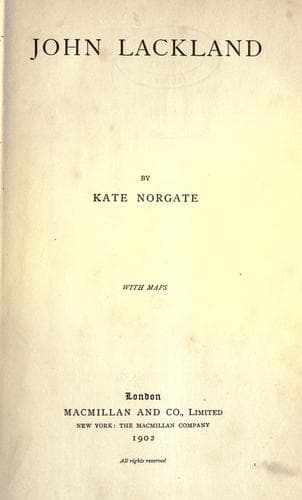
Great Britain -- History -- John, 1199-1216; Great Britain -- Kings and rulers -- Biography; John, King of England, 1167-1216
John’s point of view--only if the friendship could be made something
much more close and indissoluble than the ordinary official relation
between the Pope and every Christian sovereign. He must bind the Pope
to his personal interest by some special tie of such a nature that the
interest of the Papacy itself would prevent Innocent from casting it
off or breaking it. For a sovereign of John’s character no additional
sacrifice would be involved in the device which he actually employed
for this purpose. To outward personal humiliation of any kind John was
absolutely indifferent, when there was any advantage to be gained by
undergoing it. To any humiliation which the Crown or the nation might
suffer in his person, he was indifferent under all circumstances. His
plighted faith he had never had a moment’s hesitation in breaking,
whether it were sworn to his father, his brother, his allies, or his
people, and which he would break with equal facility when sworn to the
supreme Pontiff; moreover, he took the precaution of inserting in his
charter a saving clause which he could easily have interpreted, had
occasion ever arisen, so as to reduce the whole transaction to a mere
empty form.[805] There seems, in short, to be good reason for believing
that John’s homage to the Pope was offered without any pressure from
Rome, and on grounds of deliberate policy.[806]
How far the credit or discredit--whichever it be--of that policy
belongs to John is, however, a question not easily solved. Two
years later, the English barons seem to have claimed the credit for
themselves. We are told that they besought the Pope, “as he was lord
of England,” to take their part against John, “since he well knew
that they had at his command boldly opposed the king in behalf of the
Church’s liberty, and that the king had granted an annual revenue to
Rome, and bestowed other honours on the Pope and the Roman Church,
not of his own accord, but only out of fear and under compulsion from
them.”[807]
This, if correctly reported, is a distinct assertion by the malcontent
barons that they had deliberately chosen to set up the Pope as temporal
overlord of their country, and that it was pressure from them which
had compelled John to do him homage as such. The truth probably lies
half-way between this version and that of the king. Whether the “common
counsel of the barons” was given spontaneously to John and accepted by
him, or whether it was merely a response to a proposal which he had
laid before them, there can be little doubt that each party adopted the
scheme in the hope of turning it to account against the other party.
That on the side of the barons this hope proved utterly delusive, while
on the side of John it was completely realized, simply shows once more
how far less than a match was the collective sagacity of the barons for
the single-handed dexterity of the king.
Public-domain text, read in full here on John Shaqi.
Reviews
Reviews
No reviews yet
Be the first to share your thoughts on this work.
Elsewhere in the archive
Join the Discussion
Join the discussion
Sign in to leave a comment or review.
Sign InorCreate an account