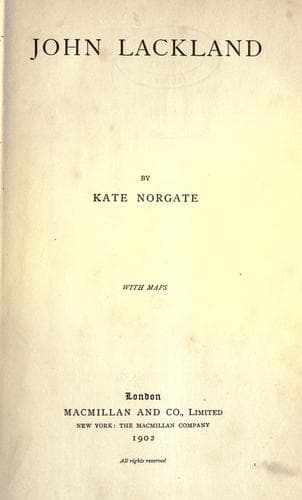
Great Britain -- History -- John, 1199-1216; Great Britain -- Kings and rulers -- Biography; John, King of England, 1167-1216
The archbishop was determined to be satisfied with nothing short of
a literal fulfilment of the promise on which he had insisted as a
condition of the king’s absolution, the promise that to “_all_ men”
their rights should be restored. He saw that this end could be gained
only by the instrumentality of the barons; he also saw that it could
be gained only by a policy based on clearer and firmer, as well as
broader and nobler, lines than any of them were capable of designing.
They, indeed, had no definite scheme of policy; nor had they any leader
able to furnish them with such a scheme. The men of highest standing
among the magnates, such as the earls of Salisbury, Chester, Albemarle,
Warren, Cornwall and William the Marshal,--the men of highest standing
among the official class, such as the heads of the houses of Aubigny,
Vipont, De Lucy, Basset, Cantelupe, Neville, Brewer[966]--had either
gone to the war or paid their scutage for it without a murmur, and
stood utterly aloof from the group of “Northerners,” among whom the
most conspicuous were two barons of secondary rank, Eustace de Vesci
and Robert Fitz-Walter. Both Eustace and Robert are said to have had
just grounds for bitter personal resentment against John; but Robert
Fitz-Walter had twice already shown himself to be both a traitor and a
coward; and on the second occasion, in 1212, Eustace de Vesci had done
the like. The pardon and restoration of both these men in the following
year was a matter of policy, but was not due to any merits of their
own.[967] It was not under the inspiration and guidance of such men as
these that the liberties of the English people could be won, nor even
that the barons could succeed in their struggle for the privileges,
pretended or real, of their own order. Another guide offered himself
to them in the person of Stephen Langton, and offered to them at the
same time a definite basis of action in the charter of Henry I. Whether
the offer was made at the meeting in S. Paul’s in August 1213, or at
some later date and in some other way, is of little consequence; it
is enough that antecedent probability and after-history alike justify
the general belief of which Roger of Wendover is the spokesman:--that
it was Langton who brought to light the charter of which the very
existence seems to have been forgotten, and it was from him that the
barons adopted it as the basis of their demands.
Public-domain text, read in full here on John Shaqi.
Reviews
Reviews
No reviews yet
Be the first to share your thoughts on this work.
Elsewhere in the archive
Join the Discussion
Join the discussion
Sign in to leave a comment or review.
Sign InorCreate an account