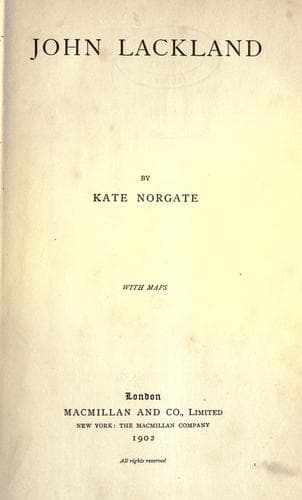
Great Britain -- History -- John, 1199-1216; Great Britain -- Kings and rulers -- Biography; John, King of England, 1167-1216
consequence of the king’s complaint of their refusal to pay the scutage
for the Poitevin war; he reproved them for their contumacy in this
matter, and “warned and exhorted” them to satisfy the king’s claims
without further delay.[986]
[Sidenote: April 19–26]
By the middle of April the two former of these letters must have
reached England, the second being probably brought back by Eustace
de Vesci and his companions. The third letter was scarcely needed to
show the barons that their cause was lost at Rome. John, moreover, had
secured its ruin in that quarter by taking the Cross[987]--partly, no
doubt, as a protection against personal violence, but still more as a
means of enlisting the Pope’s strongest sympathies in his behalf, and
holding up his enemies to execration as hinderers of the crusade. They
grew desperate; they held another council among themselves, at which
they determined, without waiting for their promised interview with the
king, that they “would deal civilly with him no longer”;[988] and in
Easter week they assembled at Stamford in arms.
Five earls and forty barons are mentioned by name as present at the
muster, “with many others”; they all came with horses and arms, and
brought with them “a countless host,” estimated to comprise about
two thousand knights, besides other horsemen, sergeants-at-arms, and
foot soldiers.[989] “And because for the most part they came from the
north, they were all called Northerners.” From Stamford they marched to
Northampton, but without doing any act of violence.[990] John, who had
spent Easter in London,[991] sent the primate and some other bishops
and magnates to parley with them.[992] Several meetings appear to have
taken place. The deliberations evidently turned chiefly on the Pope’s
letters. No allusion is made by the chroniclers to the letter about
the scutage, which perhaps had not yet arrived; but, on the one hand,
Innocent’s condemnation of secret conspiracies could not be ignored;
and on the other, the barons urged his injunction to the king to
hearken to their “just petitions.”[993] At length John--secure in the
consciousness that he could refuse every petition on the plea that it
was not just--authorized his commissioners to demand of the barons, in
his name, a categorical statement of the laws and liberties which they
desired.
Public-domain text, read in full here on John Shaqi.
Reviews
Reviews
No reviews yet
Be the first to share your thoughts on this work.
Elsewhere in the archive
Join the Discussion
Join the discussion
Sign in to leave a comment or review.
Sign InorCreate an account