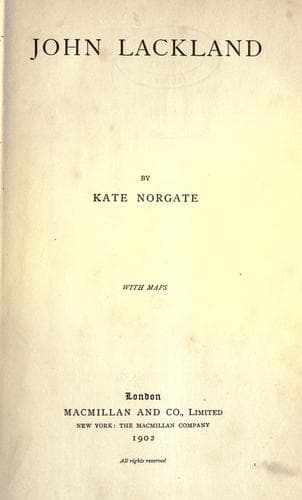
Great Britain -- History -- John, 1199-1216; Great Britain -- Kings and rulers -- Biography; John, King of England, 1167-1216
1. The earliest mention of John’s unsuccessful attempt to entrap
the wife of Eustace de Vesci is in an addition made by a chronicler
at Furness Abbey, writing c. 1270–1298, to the Stanley chronicler’s
continuation of the history of William of Newburgh. This Furness writer
(Howlett, _Chron. of Stephen_, etc., vol. ii. p. 521) merely states the
bare fact, without any details, in the briefest and simplest way, and
without any clue to the date. Walter of Hemingburgh, who was living
in 1313, tells the story in an elaborate form which is certainly not
impossible, perhaps not even very improbable, although it somewhat
resembles a story in Procopius (see _Dic. Nat. Biogr._ “Vesci, Eustace
de”). Walter gives it as an illustration of John’s character, of which
he inserts a picture--painted in the most frightful colours--between
the coming of the Franciscans in 1212 and the rising of the barons in
1215; but he connects the incident directly with the latter event,
representing Eustace as inducing those of his fellow-barons whom the
king had injured in a similar way to join him in a common effort for
vengeance, which widens into the struggle for the Charter (Hemingburgh,
vol. i. pp. 247–9). The affair would thus seem to have occurred some
years after Eustace’s desertion from the king’s host and flight from
England in 1212; a desertion for which, therefore, it cannot serve as
an excuse.
2. The legend of Robert Fitz-Walter’s daughter which became famous in
prose and verse in the sixteenth and seventeenth centuries is based
upon a passage in the Chronicle of Dunmow, printed in _Monasticon_,
vol. vi. pt. i. p. 147. This chronicle, written in a monastery of which
the Fitz-Walters were patrons, begins with the year 1054, but the MS.
(Cott. Cleopatra C. iii.) is of the end of the fifteenth century; it
ends at the year 1501. The story is placed in 1216, and is briefly
this: John demands Robert’s daughter, the fair maiden Matilda; her
father refuses to give her up to him; the civil war breaks out, and
the city of London joins the barons; afterwards they are worsted,
whereupon the king destroys Robert’s fortress in London--Castle
Baynard--and causes Matilda to be poisoned at Robert’s manor of Dunmow.
Meanwhile Robert has fled to France. War continues on both sides of
the Channel. Presently John goes to France, and has a conference with
Philip Augustus; Robert Fitz-Walter displays his prowess in a single
combat in presence of both the kings; John admires his valour, they are
reconciled, and remain friends from that time forth.
Public-domain text, read in full here on John Shaqi.
Reviews
Reviews
No reviews yet
Be the first to share your thoughts on this work.
Elsewhere in the archive
Join the Discussion
Join the discussion
Sign in to leave a comment or review.
Sign InorCreate an account