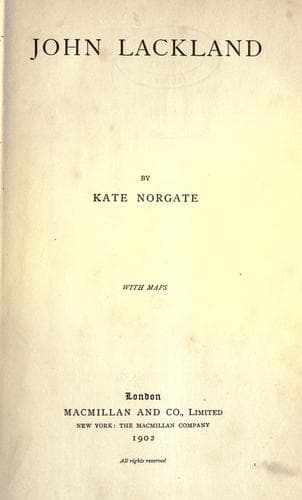
Great Britain -- History -- John, 1199-1216; Great Britain -- Kings and rulers -- Biography; John, King of England, 1167-1216
[217] R. Howden, vol. iii. p. 252. Some of John’s English lands had
been seized before the council of Nottingham; no doubt, by virtue of
the decree passed at the council in London on February 10. In the Pipe
Roll of Michaelmas 1194 the king’s officers accounted to the king’s
treasury for the ferms of Nottinghamshire, Derbyshire, Dorset and
Somerset, the third penny of Gloucestershire, and the ferm of Eye, for
half a year (P.R. 6 Ric. I. m. 6, 13, 16, 4 d); but the sheriff of
Devon and Cornwall rendered his account for three-quarters of a year
(_ib._ m. 12); while the forfeiture of John’s private estates in Dorset
and Somerset seems to have been dated from Ash-Wednesday, February
23 (_ib._ m. 13 d); a part at least of the honour of Gloucester,
viz. Bristol, had been seized at Mid-Lent, four days after Richard’s
landing in England, and the whole not later than Easter (_ib._ m. 16
d); and for the honours of Peverel and Tickhill a whole year’s ferm was
reckoned as due to the treasury at Michaelmas (_ib._ m. 6). The king’s
escheators rendered a separate account of a number of escheats in the
honour of Lancaster and in the counties which John had held (_ib._ m.
2, 2 d); and the sheriff of Dorset and Somerset gathered in for the
king a quantity of “arrears of debts which were owed to Count John for
pleas and amercements of the men and townships” of those two counties
(_ib._ m. 13). The commission issued to the itinerant justices in the
same month of September contained an express order that they should
inquire into and report upon all John’s property, real and personal,
and all the moneys owed to him, to the intent that the whole might be
secured for the king, R. Howden, vol. iii. pp. 263, 264.
[218] R. Howden, vol. iii. p. 252.
[219] _Hist. de. G. le Mar._ vv. 10491–517.
[220] W. Newb. l. iv. c. 40; Rigord, c. 94.
[221] _Hist. de. G. le Mar._ vv. 10516–20.
[222] Rigord, c. 96.
[223] W. Armor. _Gesta Phil. Aug._ c. 72; _Philipp._ l. iv. vv.
445–62. The last detail seems to imply that the victims of the
surprise--whatever its character--were, after all, not the whole
garrison, but probably only the officers.
[224] Rigord, c. 96.
[225] R. Howden, vol. iii. p. 253.
[226] Rigord, c. 100; W. Armor. _Gesta P. A._ c. 74; _Philipp._ l. iv.
vv. 530–69.
[227] W. Armor. _Philipp._ l. v. vv. 30–32.
[228] R. Howden, vol. iii. p. 286.
[229] I can find no mention either of the honour of Eye or of that of
Gloucester in Pipe Roll 7 Ric. I. (1196).
[230] R. Howden, vol. iv. p. 5.
[231] R. Howden, vol. iv. p. 16. Cf. W. Newb. l. v. c. 31.
[232] Deville, _Hist. du Château-Gaillard_, pp. 21, 22, 119–23.
[233] R. Howden, vol. iv. p. 60.
[234] R. Howden, vol. iv. p. 81.
[235] R. Coggeshall, p. 99.
[236] R. Howden, vol. iv. p. 83. The fourth part of the royal treasure
was to be given to Richard’s servants and to the poor.
[237] _Ib._ p. 84.
Public-domain text, read in full here on John Shaqi.
Reviews
Reviews
No reviews yet
Be the first to share your thoughts on this work.
Elsewhere in the archive
Join the Discussion
Join the discussion
Sign in to leave a comment or review.
Sign InorCreate an account