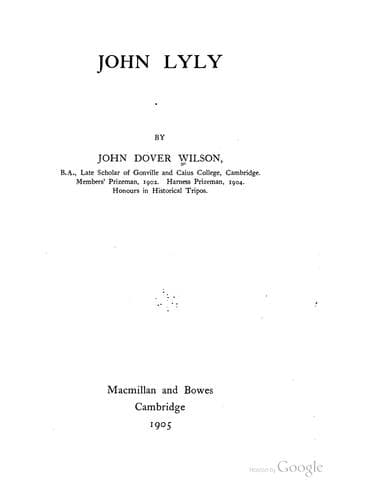
Lyly, John, 1554?-1606 -- Criticism and interpretation
as the two essentials of the ideal life, were certainly the
distinguishing marks of the New Birth; and the men of that age demanded
it in their literature. The drama of horror, the drama of insanity, the
drama of blood, all were found on the Elizabethan stage, and all
attracted large audiences. People delighted to read accounts of
contemporary crime; often these choice morsels were dished up for them
by some famous writer, as Kyd did in _The Murder of John Brewer_. The
taste for realism is by no means a purely 19th century product.
Moreover, the Elizabethans soon wearied of sameness; only a writer of
the greatest versatility, such as Shakespeare, could hope for success,
or at least financial success; and it was, perhaps, in order to revive
his waning popularity that Lyly took to realism. But the child of
fashion is always the earliest to become out of date, and we cannot
think that _Mother Bombie_ did much towards improving our author's
reputation.
[122] For title-page, Bond, III. p. 1, date 1632.
At this point of our enquiry it will be as well to say a few words upon
the lyrics which Lyly sprinkled broadcast over his plays. From an
aesthetic point of view these are superior to anything else he wrote.
"Foreshortened in the tract of time," his novel, his plays, have become
forgotten, and it is as the author of _Cupid and my Campaspe played_
that he is alone known to the lover of literature. There is no need to
enter into an investigation of the numerous anonymous poems which Mr
Bond has claimed for him[123]; even if we knew for certain that he was
their author, they are so mediocre in themselves as to be unworthy of
notice, scarcely I think of recovery. But let us turn to the songs of
his dramas, of which there are 32 in all. These are, of course, unequal
in merit, but the best are worthy to be ranked with Shakespeare's
lyrics, and our greatest dramatist was only following Lyly's example
when he introduced lyrics into his plays. I have already pointed out
that music was an important element in our early comedy. Udall had
introduced songs into his _Roister Doister_, and we have them also in
_Gammer Gurton_ and _Damon and Pithias_, but never, before Lyly's day,
had they taken so prominent a part in drama, for no previous dramatist
had possessed a tithe of Lyly's lyrical genius. Every condition favoured
our author in this introduction of songs into his plays. He had
tradition at his back; he was intensely interested in music, and
probably composed the airs himself; and lastly he was master of a choir
school, and would therefore use every opportunity for displaying his
pupils' voices on the stage. Too much stress, however, must not be laid
upon this last condition, because Lyly had already written three songs
for _Campaspe_ and four for _Sapho and Phao_ before he became connected
with St Paul's, a fact which points again to de Vere, himself a lyrist
of considerable powers, as Lyly's adviser and master. Doubts, indeed,
Public-domain text, read in full here on John Shaqi.
Reviews
Reviews
No reviews yet
Be the first to share your thoughts on this work.
Elsewhere in the archive
Join the Discussion
Join the discussion
Sign in to leave a comment or review.
Sign InorCreate an account