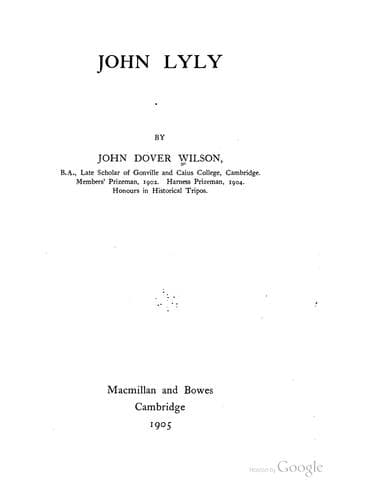
Lyly, John, 1554?-1606 -- Criticism and interpretation
way; and before his death he realised with bitterness that he was only a
stepping-stone for young Shakespeare to mount his throne. He was,
indeed, the draughtsman of the Elizabethan workshop, planning and
designing what others might build. He was the expert mathematician who
formulated the laws which enabled Shakespeare to read the stars. Of the
heights and depths of passion he was unconscious; he was no
psychologist, laying bare the human soul with the lancet; and though now
and again, as in _Endymion_, he caught a glimpse of the silver beauties
of the moon, he had no conception of the glories of the midday sun.
And yet though he lacked the poet's sense, his wit did something to
repair the defect, and even if it has a musty flavour for our pampered
palates, it saves his writings from becoming unbearably wearisome; and
moreover his fun was without that element of coarseness which mars the
comic scenes of later dramatists who appealed to more popular audiences.
But it is quite impossible for us to realise how brilliant his wit
seemed to the Elizabethans before it was eclipsed by the genius of
Shakespeare. Even as late as 1632 Blount exclaims, "This poet sat at the
sunne's table," words referring perhaps more especially to Lyly's
poetical faculty, but much truer if interpreted as an allusion to his
wit. The genius of our hero played like a dancing sunbeam over the early
Elizabethan stage. Never before had England seen anything like it, and
we cannot wonder that his public hailed him in their delight as one of
the greatest writers of all time. How could they know that he was only
the first voice in a choir of singers which, bursting forth before his
notes had died away, would shake the very arch of heaven with the
passion and the beauty of their song? But for us who have heard the
chorus first, the recitative seems poor and thin. The magic has long
passed from _Euphues_, once a name to conjure with, and even the plays
seem dull and lifeless. That it should be so was inevitable, for the wit
which illuminated these works was of the time, temporary, the earliest
beam of the rising sun. This sunbeam it is impossible to recover, and
with all our efforts we catch little but dust.
Public-domain text, read in full here on John Shaqi.
Reviews
Reviews
No reviews yet
Be the first to share your thoughts on this work.
Elsewhere in the archive
Join the Discussion
Join the discussion
Sign in to leave a comment or review.
Sign InorCreate an account