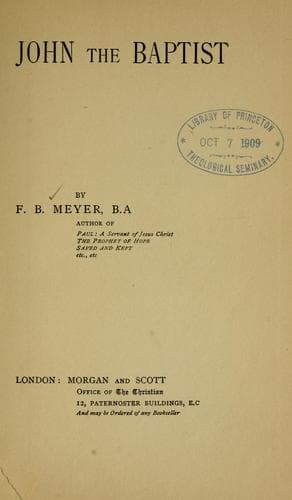
John the BaptistMeyer, F. B. (Frederick Brotherton)
Religion
John the Baptist
Meyer, F. B. (Frederick Brotherton)
Bible. New Testament -- Biography; John the Baptist, Saint
In this connection, it is interesting to consider one sentence dropped
by the sacred chronicler. He tells us, that when Herod heard of the
works of Jesus, he said immediately, "It is John the Baptist--he is
risen from the dead." Herod could not believe that that mighty
personality was quenched, even for this life, by that one blow of the
executioner's sword. Surely he had risen! There was a feverish dread
that he would yet be confronted by the murdered man, whose face haunted
his dreams. His courtiers, ready to take the monarch's cue, would be
equally credulous. From one to another the surmise would pass--"John
the Baptist is risen from the dead."
Why, then, did that myth not spread, until it became universally
accredited? Ah, there was no chance of such a thing, for the simple
reason that there was the grave of John the Baptist to disprove it. If
Herod had seriously believed it, or the disciples of John attempted to
spread it, nothing would have been easier than to exhume the body from
its sepulture, and produce the ghastly but indubitable refutation of
the royal delusion.
When the statement began to spread and gain credence that Christ had
risen from the dead; when Peter and John stood up and affirmed that He
was living at the right hand of God; if it had been a mere surmise, the
fond delusion of loyal and faithful hearts, an hallucination of two or
three hysterical women--would it not have been easy for the enemies of
Christianity to go forthwith to the grave in the garden of Joseph, and
produce the body of the Crucified, with the marks of the nails in hands
and feet? Why did they not do it? If it be said that it could not be
produced, because it had been taken away, let this further question be
answered: Who had taken it away? Not his friends; for they would have
taken the cerements and wrappings with which Joseph and Nicodemus had
enswathed it. Not his enemies; for they would have been only too glad
to produce it. What glee in the grim faces of Caiaphas and Annas, if
at the meeting of the Sanhedrim, called to deal with the new heresy,
there could have been given some irrefragable proof that the body of
Jesus was still sepulchred, if not in Joseph's tomb, yet somewhere
else, to which their emissaries had conveyed it!
Public-domain text, read in full here on John Shaqi.
Reviews
Reviews
No reviews yet
Be the first to share your thoughts on this work.
Elsewhere in the archive
Join the Discussion
Join the discussion
Sign in to leave a comment or review.
Sign InorCreate an account