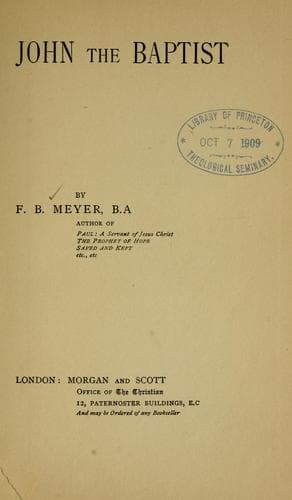
John the BaptistMeyer, F. B. (Frederick Brotherton)
Religion
John the Baptist
Meyer, F. B. (Frederick Brotherton)
Bible. New Testament -- Biography; John the Baptist, Saint
When Jesus lay in his grave, this process of disintegration began at
once among his followers also. The women went to embalm Him; the men
were apart. Peter and John broke off together--at least they ran
together to the sepulchre; but where were the rest? Two walked to
Emmaus apart; whilst Thomas was not with them when Jesus came on the
evening of Easter Day. As soon as the breath leaves the body
disintegration begins; and when Jesus was dead, as they supposed, the
same process began to show itself. Soon Peter would have been back in
Gennesaret; Nathanael beneath his fig-tree, Luke in his dispensary, and
Matthew at his toll-booth.
What arrested that process and made it impossible? Why did the day,
which began with a certain amount of separation and decay, end with a
closer consolidation than ever, so that they were, for the most part,
gathered in the upper room; and forty days after they were all with one
accord in one place? Why was it that they who had been like timid
deer, before He died, became as lions against the storm of Pharisaic
hate, and stronger as the weeks passed?
There is only one answer to these questions. The followers of Jesus
were convinced by irrefragable proofs that their Master was living at
the right hand of power; nay, that He was with them all the
days--nearer them than ever before, as much their Head and Leader as at
any previous moment. When the shepherd is smitten, the flock is
scattered; and this flock was not scattered, because the Shepherd had
recovered from his mortal wound, and was alive for evermore.
And surely the evidence which sufficed for them is enough for us.
Again and again, in dark hours, when I have longed to have the
demonstration of sense added to that of faith, it has been an untold
comfort to feel that sufficient evidence was given to the Lord's
disciples to persuade them against their contrary expectations and
unbelief; to hold them together in spite of every possible inducement
to disperse, and to transform a number of units into the Church,
against which the gates of hell have not been able to prevail. If they
were convinced, we may be. If their eyes beheld and their hands
touched the body of the risen Lord, we may be of good cheer. Their
behaviour proves that they were thoroughly convinced. They acted as
only those can act whose feet are on a rock. They knew whom they had
believed; and they had no doubt that He would perfect the work which He
had begun. What He had begun in the flesh, He would perfect in the
Spirit.
Public-domain text, read in full here on John Shaqi.
Reviews
Reviews
No reviews yet
Be the first to share your thoughts on this work.
Elsewhere in the archive
Join the Discussion
Join the discussion
Sign in to leave a comment or review.
Sign InorCreate an account