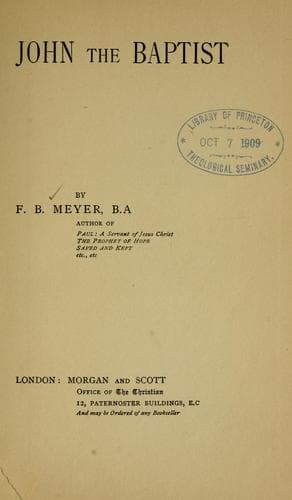
John the BaptistMeyer, F. B. (Frederick Brotherton)
Religion
John the Baptist
Meyer, F. B. (Frederick Brotherton)
Bible. New Testament -- Biography; John the Baptist, Saint
It is remarkable that the prophet Malachi tells us that the advent of
the Messiah should be preceded and heralded by Elijah the prophet; and
that Gabriel, four hundred years after, said that John the Baptist,
whose birth he announced, would come in the spirit and power of Elijah.
This double prediction was referred to by our Lord when, descending
from the Mount of Transfiguration, in conversation with the apostles,
He indicated John the Baptist as the Elijah who was to come. And,
indeed, there was a marvellous similarity between these two men, though
each of them is dwarfed into insignificance by the unique and original
personality of the Son of Man, who towers in inaccessible glory above
them.
I. LET US INSTITUTE A COMPARISON BETWEEN ELIJAH THE TISHBITE, AND JOHN
THE BAPTIST.--They resembled each other in dress. We are told that
Elijah was a hairy man--an expression which is quite as likely to refer
to the rough garb in which he was habited, as to the unshorn locks that
fell upon his shoulders. And John the Baptist wore a coarse dress of
camel's hair.
Each of them sojourned in Gilead. In the remarkable sentence, which,
for the first time, introduces Elijah to the Bible and the world, we
are told that he was one of the sojourners in Gilead, that great tract
of country, thinly populated, and largely given over to shepherds and
their flocks, which lay upon the eastern side of the Jordan. And we
know that it was there amid the shaggy forests, and closely-set
mountains, with their rapid torrents, that John the Baptist waited,
fulfilled his ministry, preached to and baptized the teeming crowds.
Each of them learnt to make the body subservient to the spirit. Elijah
was able to live on the sparse food brought by ravens, or provided from
the meal barrel of the widow, was able to outstrip the horses of Ahab's
chariot in their mad rush across the valley of Jezreel; and after a
brief respite, given to sleep and food, went in the strength of it for
forty days and nights, through the heart of the desert until he came to
Horeb, the Mount of God. His body was but the vehicle of the fiery
spirit that dwelt within; he never studied its gratification and
pleasure, but always handled it as the weapon to be wielded by his
soul. And what was true in his case, was so of John the Baptist, whose
food was locusts and wild honey. The two remind us of St. Bernard, who
tells us that he never ate for the gratification of taking food, but
only that he might the better serve God and man.
We remember also that each of these heroic spirits was confronted by a
hostile court. In the case of Elijah, Ahab and Jezebel, together with
the priests of Baal and Astarte, withstood every step of his career;
and in the case of John the Baptist, Herod, Herodias, and the whole
drift of religious opinion, with its repeated deputations to ask who he
might be, dogged his steps, and ultimately brought him to a martyr's
end.
Public-domain text, read in full here on John Shaqi.
Reviews
Reviews
No reviews yet
Be the first to share your thoughts on this work.
Elsewhere in the archive
Join the Discussion
Join the discussion
Sign in to leave a comment or review.
Sign InorCreate an account