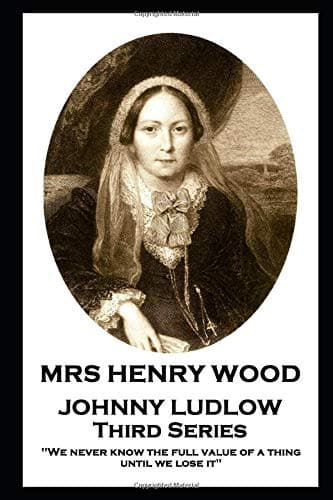
England -- Social life and customs -- 19th century -- Fiction; Short stories, English
"I think," said Mrs. Knox slowly, as if deliberating the point with
herself, and in the most affectionate of tones, "that you would be
happier in a single life, Arnold. One never knows what a wife is till
she's tried."
"Do you think so? Well, we must leave it to the future. What will be,
will be."
IV.
And now I am taking up the story for myself; I, Johnny Ludlow. Had I
gone straight on with it after that last night of Janet's sleep-walking
at Miss Deveen's, you would never have understood.
It was on the Saturday night that Janet was found out--as any one must
remember who took the trouble to count up the nights and days. On the
Sunday morning early, Miss Deveen's doctor was sent for. Dr. Galliard
happened to be out of town, so Mr. Black attended for him. Cattledon was
like vinegar. She looked upon Janet's proceedings as a regular scandal,
and begged Miss Deveen's pardon for having brought her niece into the
house. Upon which she was requested not to be silly.
Miss Deveen told the whole tale of the lost bank-note, to me and to
Helen and Anna Whitney: at least, as much as she knew of it herself.
Janet was innocent as a child; she felt sure of that, she said, and
much to be pitied; and that Mrs. Knox, of Lefford, seemed to be a most
undesirable sort of person. To us it sounded like a romance, or a story
out of a newspaper police-report.
Monday came in; a warm, bright April day. I was returning to Oxford in
the evening--and why I had not returned in the past week, as ought to
have been the case, there's no space to tell here. Miss Deveen said we
might go for a walk if we liked. But Helen and Anna did not seem to care
about it; neither did I, to say the truth. A house with a marvel in it
has attractions; and we would by far rather have gone upstairs to see
Janet. Janet was better, quite composed, but weak, they said: she was up
and dressed, and in Miss Deveen's own blue-room.
"Well, do you mean to go out, or not, you young people?" asked Miss
Deveen. "Dear me, here are visitors!"
George came in bringing a card. "Dr. Knox."
"Why!--it must be some one from that woman at Lefford!" exclaimed Miss
Deveen, in an undertone to me. "Oh no; I remember now, Johnny; Dr. Knox
was the step-son; _he_ was away, and had nothing to do with it. Show Dr.
Knox in, George."
A tall man in black, whom one might have taken anywhere for a doctor,
with a grave, nice face, came in. He said his visit was to Miss Carey,
as he took the chair George placed near his mistress. Just a few words,
and then we knew the whole, and saw a small sealed-up box in his hand,
which contained the remains of the bank-note.
"I am more glad than if you brought Janet a purse of gold!" cried Miss
Deveen, her eyes sparkling with pleasure. "Not that I think any one
could have doubted her, Dr. Knox--not even your step-mother, in her
heart,--but it is satisfactory to have it cleared up. It has made Miss
Carey very ill; but this will set her at rest."
Public-domain text, read in full here on John Shaqi.
Reviews
Reviews
No reviews yet
Be the first to share your thoughts on this work.
Elsewhere in the archive
Join the Discussion
Join the discussion
Sign in to leave a comment or review.
Sign InorCreate an account