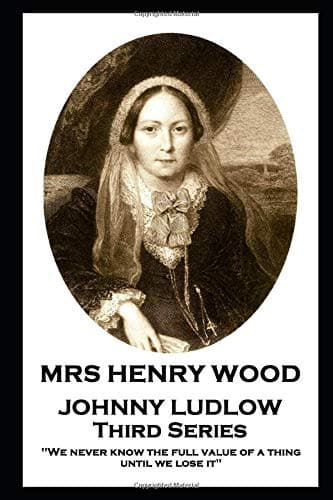
England -- Social life and customs -- 19th century -- Fiction; Short stories, English
One night I was coming, with Tod, across from Mrs. Scott's, who lived
beyond Hyde Stockhausem's. We took the field way from Church Dykely, as
being the shortest route, and that led us through the copse at the back
of Caromel's Farm. It was a very light night, though not moonlight; and
we walked on at a good rate, talking of a frightful scrape Sam Scott
had got into, and which he was afraid to tell his mother of. All in a
moment, just in the middle of the copse, we came upon a man standing
amongst the trees, his face towards us. Tod turned and I turned; and we
both saw Nash Caromel. Now, of course, you will laugh. As the Squire did
when we got home (in a white heat) and told him: and he called us a
couple of poltroons. But, if ever I saw the face of Nash Caromel, I saw
it then; and if ever I saw a figure that might be called a shadow, it
was his.
"Fine gentlemen, both of you!" scoffed the Squire. "Clear and sensible!
Seen a ghost, have you, and confess to it! Ho, ho! Running through the
back copse, you come upon somebody that you must take for an apparition!
Ha, ha! Nice young cowards! I'd write an account of it to the Worcester
papers if I were you. A ghost, with glaring eyes and a white face!
Death's head upon a mopstick, lads! I shouldn't have wondered at Johnny;
but I do wonder at you, Joe," concluded the Squire, smoothing down.
"I am no more afraid of ghosts than you are, father," quietly answered
Joe. "I was not afraid when we saw--what we did see; I can't answer for
Johnny. But I do declare, with all my senses (which you are pleased to
disparage) about me, that it was the form and face of Nash Caromel, and
that 'it' (whatever it might be) seemed to vanish from our sight as we
looked."
"Johnny calls it a shadow," mocked the Squire, amiably.
"It looked shadowy," said Tod.
"A tree-trunk, I dare be bound, lads, nothing else," nodded the Squire.
And you might as well have tried to make an impression on a post.
IV.
September came in: which made it a year since Nash died. And on one of
its bright days, when the sun was high, and the blue sky cloudless,
Church Dykely had a stir given it in the sight of the mistress of
Caromel's Farm. She and her father were in a gig together, driving off
on the Worcester road: and it was so very rare a thing to see her abroad
now, that folks ran to their windows and doors to stare. Her golden
hair, what could be seen of it for her smart blue parasol, shone in the
sunlight; but her face looked white and thin through the black crape
veil.
"Just like a woman who gets disturbed o' nights," pronounced Sam Rimmer,
thinking of the ghostly presence that was believed to haunt the house.
Public-domain text, read in full here on John Shaqi.
Reviews
Reviews
No reviews yet
Be the first to share your thoughts on this work.
Elsewhere in the archive
Join the Discussion
Join the discussion
Sign in to leave a comment or review.
Sign InorCreate an account