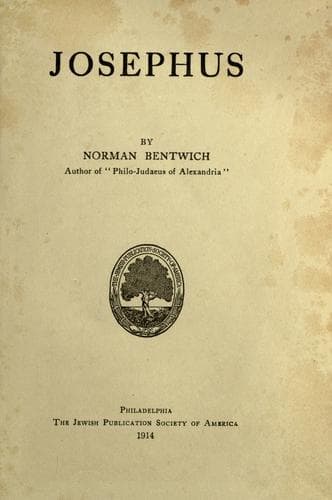
To appraise him fairly is difficult. He has few of the qualities, either
personal or literary, that attract sympathy and many of the defects that
repel. He is at once vain and obsequious, servile and spiteful,
professing candor and practising adulation, prolix and prosaic. As a
general he proved himself a traitor; as apologist of the Jews, a
function which he asserted for himself, he marred by a lack of
independence the service which he sought to render his people. In his
account of their past he was often false to their fundamental ideas of
God and history. Whether he was really under the influence of the
debased Greco-Roman culture of the day, which consigned mankind to the
dominion of fatality, or whether he deliberately masked his own
standpoint to please his audience, he presented the history of the
Hebrew nationality in the light of ideas of fate strange to it. He has
perpetuated a false picture of the Zealots, whose avowed enemy he was,
and he reveals an inadequate understanding of the deeper ideas and
deeper principles of the Pharisees, whose champion he professed to be.
Generally, in dealing with the struggle against Rome, his dominating
desire to justify his own submission and please the Romans led him to
distort the facts, and rendered him blind to the real heroism of his
countrymen. The client in him prevails over the historian: we can never
be sure whether he is expressing his own opinion or only what he
conceives will be pleasing to his patrons and masters. This dependence
affects his presentation of Judaism as well as of the Jewish people. He
dissembled his theological opinions in his larger historical works, and
it is only in his last apologetic composition that he asserts
confidently a Jewish point of view.
Public-domain text, read in full here on John Shaqi.
Reviews
Reviews
No reviews yet
Be the first to share your thoughts on this work.
Elsewhere in the archive
Join the Discussion
Join the discussion
Sign in to leave a comment or review.
Sign InorCreate an account