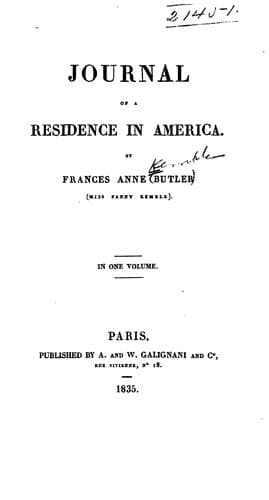
Atlantic States -- Description and travel; Kemble, Fanny, 1809-1893; United States -- Social life and customs -- 1783-1865
of landing, the engine stops, the boat is lowered--the captain always
convoys his passengers himself from the steamer to the shore--away darts
the tiny skiff, held by a rope to the main boat; as soon as it grazes
the land, its freight, animate and inanimate, is bundled out, the boat
hauls itself back in an instant, and immediately the machine is in
motion, and the vessel again bounding over the water like a
race-horse.[54] Doubtless all this has many and great advantages; but to
an English person, the mere circumstance of being the whole day in a
crowd is a nuisance. As to privacy at any time, or under any
circumstances, 'tis a thing that enters not into the imagination of an
American. They do not seem to comprehend that to be from sunrise to
sunset one of a hundred and fifty people confined in a steam-boat is in
itself a great misery, or that to be left by one's self and to one's
self can ever be desirable. They live all the days of their lives in a
throng, eat at ordinaries of two or three hundred, sleep five or six in
a room, take pleasure in droves, and travel by swarms.[55]
* * * * *
In spite, therefore, of all its advantages, this mode of journeying has
its drawbacks, and the greatest of all, to me, is the being
_companioned_ by so many strangers, who crowd about you, pursue their
conversation in your very ears, or, if they like it better, listen to
yours, stare you out of all countenance, and squeeze you out of all
comfort. It is perfectly intolerable to me; but then I have more than
even the national English abhorrence of coming in contact with
strangers. There is no moment of my life when I would not rather be
alone than in company; and feeling, as I often do, the society of even
those I love a burden, the being eternally surrounded by indifferent
persons is a positive suffering that interferes with every enjoyment,
and makes pleasure three parts endurance. I think this constant living
in public is one reason why the young women here are much less retiring
and shy than English girls. Instead of the domestic privacy in which
women among us are accustomed to live, and move, and have their being,
here they are incessantly, as Mr. ---- says, "_en évidence_." Accustomed
to the society of strangers, mixing familiarly with persons of whom they
know nothing earthly, subject to the gaze of a crowd from morning till
night, pushing, and pressing, and struggling in self-defence,
conversing, and being conversed with, by the chance companions of a
boarding-house, a steam-boat, or the hotel of a fashionable
watering-place, they must necessarily lose every thing like reserve or
bashfulness of deportment, and become free and familiar in their
manners, and noisy and unrefined in their tone and style of
conversation.[56] An English girl of sixteen, put on board one of these
Noah's arks (for verily there be clean and unclean beasts in them),
would feel and look like a scared thing. To return to our progress.
Public-domain text, read in full here on John Shaqi.
Reviews
Reviews
No reviews yet
Be the first to share your thoughts on this work.
Elsewhere in the archive
Join the Discussion
Join the discussion
Sign in to leave a comment or review.
Sign InorCreate an account