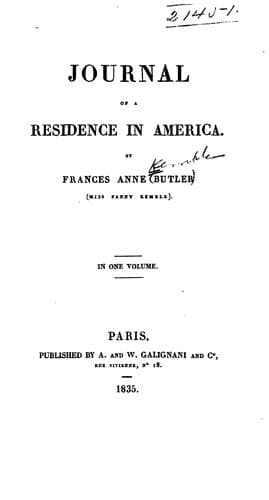
Atlantic States -- Description and travel; Kemble, Fanny, 1809-1893; United States -- Social life and customs -- 1783-1865
he had come to this country in early life, with three halfpence in his
pocket, and a nail and hammer in his hand, for all worldly substance;
how he had earned his bread by making nails, which was his business in
Scotland; how, one day, passing by some flowers exposed for sale, he had
touched a geranium leaf by accident, and, charmed with its fragrance,
bought it, having never seen one before; how, with fifteen dollars in
his pocket, he commenced the business of a florist and gardener; and how
he had refused as many thousand dollars for his present prosperous
concern; how, when he first came to New York, the place opposite his
garden, where now stands a handsome modern dwelling-house, was the site
of a shed where he did his first bit of work; how, after six-and-twenty
years' absence from Scotland, he returned home; how he came to his
father's house--"'Twas on a bright morning in August--the eighth of
August, just, it was--when I went through the door. I knew all the old
passages so well: I opened the parlour door, and there, according to the
good old Scottish custom, the family were going to prayers afore
breakfast. There was the old Bible on the table, and the old clock
ticking in the corner of the room; there was my father in his own old
chair, exactly just where I had left him six-and-twenty years gone by.
The very shovel and tongs by the fire were the same; I knew them all. I
just sat down, and cried as sweetly as ever a man did in his life."
These were, as nearly as I can recollect, his words; and oh, what a
story! His manner, too, was indescribably vivid and graphic. My father's
eyes filled with tears. He stretched out his hand, and grasped and shook
the Scotchman's hand repeatedly without speaking; I never saw him more
excited. I never was more struck myself with the wonderful strangeness
of this bewildering life. He showed us the foot of a rude rustic-looking
table. "That," he said, "was cut from out the hawthorn hedge that grows
by my father's house; and this," showing us a wooden bowl, "is what I
take my _parritch_ in!" I asked him if he never meant to leave this
country, and return to bonny Scotland. He said, No, never: he might
return, but he never meant to settle any where but here. "For," added
he, "I have grown what I am in it, madam, and 'tis a fine country for
the poor." He had been an early martyr, too, to his political opinions;
and, when only nineteen years of age, had been imprisoned in Edinburgh
for advocating the cause of that very reform which the people are at
this moment crying jubilee over in England. He seemed to rejoice in this
country, as in the wide common land of political freedom, unbounded by
the limits of long-established prejudice, unbroken by the deep trenches
which divide class from class in the cultivated soil of the old world. I
could have listened to this strange oracle for a day; but in the midst
of his discourse he was summoned to dinner; and presenting his son to
Public-domain text, read in full here on John Shaqi.
Reviews
Reviews
No reviews yet
Be the first to share your thoughts on this work.
Elsewhere in the archive
Join the Discussion
Join the discussion
Sign in to leave a comment or review.
Sign InorCreate an account