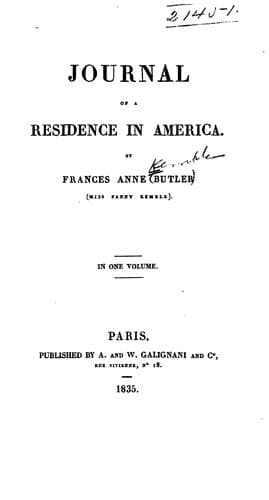
Atlantic States -- Description and travel; Kemble, Fanny, 1809-1893; United States -- Social life and customs -- 1783-1865
'Tis otherwise with tragic
representations. They are unnatural, not positively, but comparatively
unnatural; the incidents are, for the most part, strange, startling,
unusual; and though they always must be within possibility, in order to
excite the sympathies of beholders,--though some of them may even be
historical facts,--yet they are, for the most part, events which come
within the probabilities of few of us, and this renders necessary a
degree of excitement and elevation in the mind of the spectator, foreign
to, and at variance with, the critical spirit of prosaic reality. Again,
the scene of a comedy is generally a drawing-room; and the smaller the
stage, the greater is the possibility of rendering it absolutely like
what we all have seen, and are daily in the habit of seeing; but to
represent groves and mountains, or lakes, or the dwellings of the kings
of the earth, satisfactorily to the spectator's mind, there must be a
certain distance observed, from which the fancy may take its stand for
the best perception of what is intended. Whereas, in closer contact with
such scenes, not only does their immediate proximity convey an
unpleasing consciousness of the unreality of the whole, but the near and
absolute detail of paint, canvass, and gilding, is obtruded in a manner
that destroys all illusion, and, by disturbing the effect of the whole
upon the spectator, necessarily weakens that part which depends solely
upon the actor. The same thing applies to dress. Foil-stone, paste, and
coloured glass, by French ingenuity have been manufactured into toys,
which, with the help of distance, may be admitted as representing the
splendours of Eastern costume, or even the glittering trappings of those
gaudy little superhumans, the fairies. But nearness utterly dissolves
the spell, and these substitutes for magnificence become palpable
impositions, and very often most ludicrous ones. I have often been
accused of studying my attitudes; but the truth is, that most things
that are presented to my imagination, instead of being mere
abstractions, immediately assume form and colour, and become pictures;
these I constantly execute on the stage as I had previously seen them in
my fancy: but as few pictures as large as life admit of being seen to
best effect immediately close to the spectator, so the whole effect
produced by a graceful attitude, fine colours, or skilful grouping on
the stage, is considerably diminished when the space is restricted, and
the audience brought too near the performers. So much for little
theatres. ---- came in after the play. He told us that as he was coming
out of the theatre, a Kentuckian accosted him with, "Well, what do you
think of that 'ere _gal_?"--"Oh," hesitatingly replied ----, "I don't
quite know."--"Well," retorted the questioner, "any how, I guess she's
o' some account!"
_Tuesday, 15th._
Public-domain text, read in full here on John Shaqi.
Reviews
Reviews
No reviews yet
Be the first to share your thoughts on this work.
Elsewhere in the archive
Join the Discussion
Join the discussion
Sign in to leave a comment or review.
Sign InorCreate an account