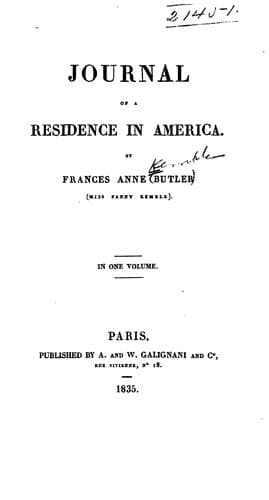
Atlantic States -- Description and travel; Kemble, Fanny, 1809-1893; United States -- Social life and customs -- 1783-1865
too unsheltered for comfort either in summer or winter, but the view
from its site is beautiful, and we had it in perfection to-day. Standing
at an elevation of more than a hundred feet from the river, we looked
down its magnificent, broad, silvery avenue, to the Narrows--that rocky
gate that opens towards my home. New York lay bright and distinct on the
opposite shore, glittering like a heap of toys in the sunny distance:
the water towards Sandy Hook was studded with sails; and far up on the
other side the river rolled away among shores that, even in this wintry
time of bare trees and barren earth, looked gay and lovely in the
sunshine. We turned down again; but after crossing the bridge over the
pretty brook, we took an upper path to the right, and riding through
some leafless, warm, sunny woodlands, joined the road that leads to the
Weehawken height, and so returned to New York. On our way, discussing
the difference between religion as felt by men and women, ---- agreed
with me, that hardly one man out of five thousand held any distinct
entire and definite religious belief. He said that religion was a
sentiment, and that, as regarded all creeds, there was no midway with
them; that faith or utter disbelief were the only alternatives; for that
displacing one jot of any of them made the whole totter,--which last is,
in some measure, true, but I do not think it is true that religion is
_only_ a sentiment. There are many reasons why women are more religious
than men. Our minds are not generally naturally analytical--our
education tends to render them still less so: 'tis seldom in a woman's
desire (because seldom in her capacity) to investigate the abstract
bearings of any metaphysical subject. Our imaginations are exceedingly
sensitive, our subservience to early impressions, and exterior forms,
proportionate; and our habits of thought, little enlarged by experience,
observation, or proper culture, render us utterly incapable of almost
any logical train of reasonings. With us, I think, therefore, faith is
the only secure hold; for disbelief, acting upon mental constructions so
faulty and weak, would probably engender insanity, or a thousand species
of vague, wild, and mischievous enthusiasms.[91] I believe, too, that
women are more religious than men, because they have warmer and deeper
affections. There is nothing surely on earth that can satisfy and
utterly fulfil the capacity for loving which exists in every woman's
nature. Even when her situation in life is such as to call forth and
constantly keep in exercise the best affections of her heart, as a
wife, and a mother, it still seems to me as if more would be wanting to
fill the measure of yearning tenderness, which, like an eternal
fountain, gushes up in every woman's heart; therefore I think it is that
we turn, in the plenitude of our affections, to that belief which is a
religion of love, and where the broadest channel is open to receive the
Public-domain text, read in full here on John Shaqi.
Reviews
Reviews
No reviews yet
Be the first to share your thoughts on this work.
Elsewhere in the archive
Join the Discussion
Join the discussion
Sign in to leave a comment or review.
Sign InorCreate an account