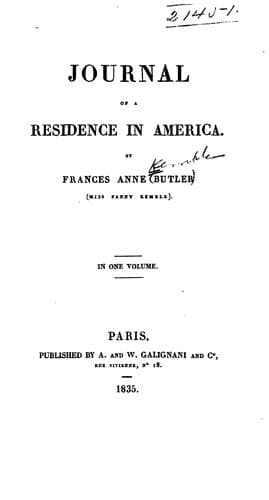
Atlantic States -- Description and travel; Kemble, Fanny, 1809-1893; United States -- Social life and customs -- 1783-1865
I have seen ----, who in his outward man bears but little token of his
inward greatness. Miss ---- had prepared me for an exterior over which
debility and sickness had triumphed now for some years; but, thought I,
there must be eyes and a brow; and there the spirit will surely be seen
upon its throne. But the eyes were small grey eyes, with an expression
which struck me at first as more akin to shrewdness of judgment, than
genius and the loftier qualities of the mind; and though the brow and
forehead were those of an intellectual person, they had neither the
expanse nor conformation I had imagined. The subject of our
conversation, though sufficiently natural for him to choose, addressing
one of my craft, did not appear to me to be a happy one for his own
powers,--perhaps I thought so because I differed from him. He talked
about the stage and acting in as unreal, and, in my opinion, mistaken, a
manner as possible. Had he expressed himself unknowingly about acting,
that would not have surprised me; for he can have no means of judging of
it, not having frequented the theatre for some years past: and those who
have the best means of forming critical judgments upon dramatic subjects
for the most part talk arrant nonsense about them. Lawrence was the only
man I ever heard speak about the stage who did so with understanding and
accuracy. I have heard the very cleverest men in England talk the
greatest stuff imaginable about actors and acting. But to return to
----: he said he had not thought much upon the subject, but that it
appeared to him feasible and highly desirable to take detached passages
and scenes from the finest dramatic writers, and have them well
declaimed in comparatively private assemblies,--this as a wholesome
substitute for the stage, of which he said he did not approve; and he
thought this the best method of obtaining the intellectual pleasure and
profit to be derived from fine dramatic works, without the illusion and
excitement belonging to theatrical exhibitions. My horror was so
unutterable at this proposition, and my amazement so extreme that he
should make it, that I believe my replies to it were all but incoherent.
What! take one of Shakspeare's plays bit by bit, break it piece-meal, in
order to make recitals of it!--destroy the marvellous unity of one of
his magnificent works, to make patches of declamation! If the stage is
evil, put it away, and put away with it those writings which properly
belong to it, and to nothing else; but do not take dramatic
compositions, things full of present action and emotion, to turn them
into recitations,--and mutilated ones too. Get other poems to declaim,
no matter how vivid or impassioned in their descriptions, so their form
be not dramatic. It is not to be supposed that the effect proper and
natural to a fine dramatic conception can be preserved when the language
is merely declaimed without the assistance of distance, dress, scenic
Public-domain text, read in full here on John Shaqi.
Reviews
Reviews
No reviews yet
Be the first to share your thoughts on this work.
Elsewhere in the archive
Join the Discussion
Join the discussion
Sign in to leave a comment or review.
Sign InorCreate an account