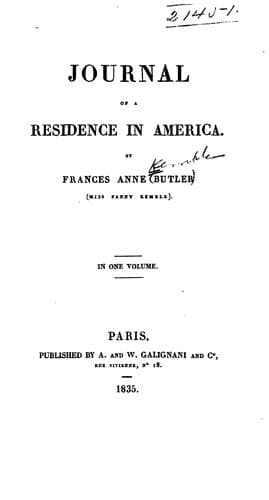
Atlantic States -- Description and travel; Kemble, Fanny, 1809-1893; United States -- Social life and customs -- 1783-1865
[54] Of course the captain is undisputed master of the boat, and any
disorders, quarrels, etc., which may arise, are settled by his
authority. Any passenger, guilty of misbehaviour, is either confined or
sent immediately on shore, no matter how far from his intended
destination. I once saw very summary justice performed on a troublesome
fellow who was disturbing the whole society on board one of the North
River steamers. He was put into the small boat with the captain and a
stout-looking sailor, and very comfortably deposited on some rafts which
were floating along shore, about twenty miles below West Point, whither
he was bound.
[55] The quantity of one's companions in these conveyances is not more
objectionable than their quality sometimes. As they are the only
vehicles, and the fares charged are extremely low, it follows,
necessarily, that all classes and sorts of people congregate in them,
from the ragged Irish emigrant and the boorish back-countryman, to the
gentleman of the senate, the supreme court, and the president himself.
[56] The manners of the young girls of America appear singularly free to
foreigners; and until they become better acquainted with the causes
which produce so unrestrained a deportment, they are liable to take
disadvantageous and mistaken impressions with regard to them. The term
which I should say applied best to the tone and carriage of American
girls from ten to eighteen, is hoydenish; laughing, giggling, romping,
flirting, screaming at the top of their voices, running in and out of
shops, and spending a very considerable portion of their time in
lounging about in the streets. In Philadelphia and Boston, almost all
the young ladies attend classes or day schools; and in the latter place
I never went out, morning, noon, or evening, that I did not meet, in
some of the streets round the Tremont House, a whole bevy of young
school girls, who were my very particular friends, but who, under
pretext of going to, or returning from, school, appeared to me to be
always laughing, and talking, and running about in the public
thoroughfares; a system of education which we should think by no means
desirable. The entire liberty which the majority of young ladies are
allowed to assume, at an age when in England they would be under strict
nursery discipline, appears very extraordinary; they not only walk alone
in the streets, but go out into society, where they take a determined
and leading part, without either mother, aunt, or chaperon of any sort;
custom, which renders such an appendage necessary with us, entirely
dispenses with it here; and though the reason of this is obvious enough
in the narrow circles of these small towns, where every body knows every
body, the manners of the young ladies do not derive any additional charm
from the perfect self-possession which they thus acquire. Shyness
appears to me to be a quality utterly unknown to either man, woman, or
child in America.
Public-domain text, read in full here on John Shaqi.
Reviews
Reviews
No reviews yet
Be the first to share your thoughts on this work.
Elsewhere in the archive
Join the Discussion
Join the discussion
Sign in to leave a comment or review.
Sign InorCreate an account