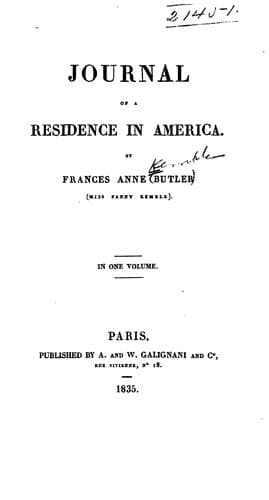
Atlantic States -- Description and travel; Kemble, Fanny, 1809-1893; United States -- Social life and customs -- 1783-1865
although the public should prefer the coarser yet far more effective
work of a painter, who, neglecting all refinement and niceness of
execution, should merely paint with such full colouring, and breadth and
boldness of touch, as to produce in the wide space he is called upon to
fill, and upon the remote senses he appeals to, the _effect_ of that
which he intends to represent. Indeed he is the better artist of the
two, though probably not the most intellectual man. For it is the part
of such a one to know exactly what will best convey to the mass of mind
and feeling to which he addresses himself the emotions and passions
which he wishes them to experience.[36] Now the great beauty of all my
father's performances, but particularly of Hamlet, is a wonderful
accuracy in the detail of the character which he represents; an accuracy
which modulates the emphasis of every word, the nature of every gesture,
the expression of every look; and which renders the whole a most
laborious and minute study, toilsome in the conception and acquirement,
and most toilsome in the execution. But the result, though the natural
one, is not such as he expects, as the reward of so much labour. Few
persons are able to follow such a performance with the necessary
attention, and it is almost as great an exertion to see it
_understandingly_, as to act it. The amazing study of it requires a
study in those who are to appreciate it, and, as I take it, this is far
from being what the majority of spectators are either capable or
desirous of doing; the actor loses his pains, and they have but little
pleasure. Those who perform, and those who behold a play, have but a
certain proportion of power of exciting, and capability of being
excited. If, therefore, the actor expends his power of exciting, and his
audience's power of being excited, upon the detail of the piece, and
continues through five whole acts to draw from both, the main and
striking points, those of strongest appeal, those calculated most to
rouse at once, and gratify the emotions of the spectator, have not the
same intensity or vigour that they would have had, if the powers of both
actor and audience had been reserved to give them their fullest effect.
A picture requires light and shadow; and the very relief that throws
some of the figures in a fine painting into apparent obscurity, in
reality enhances the effect produced by those over which the artist has
shed a stronger light. Every note in the most expressive song does not
require a peculiar expression; and an air sung with individual emphasis
on each note would be utterly unproductive of the desired effect. All
things cannot have all their component parts equal, and "nothing
pleaseth but rare accidents." This being so, I think that acting the
best which skilfully husbands the actor's and spectator's powers, and
puts forth the whole of the one, to call forth the whole of the other,
occasionally only; leaving the intermediate parts sufficiently level, to
Public-domain text, read in full here on John Shaqi.
Reviews
Reviews
No reviews yet
Be the first to share your thoughts on this work.
Elsewhere in the archive
Join the Discussion
Join the discussion
Sign in to leave a comment or review.
Sign InorCreate an account